- +233209032280
- Monday to Friday: 9am to 5pm

REAL ESTATE INVESTMENT OPPORTUNITIES IN ACCRA [PART-5]: 5 POWERFUL PULL FACTORS DRIVING THE REAL ESTATE BOOM ALONG THE ACCRA-NSAWAM CORRIDOR - AFRICAN CONTINENTAL ENGINEERING & CONSTRUCTION NETWORK
- Home
- REAL ESTATE INVESTMENT OPPORTUNITIES IN ACCRA [PART-5]: 5 POWERFUL PULL FACTORS DRIVING THE REAL ESTATE BOOM ALONG THE ACCRA-NSAWAM CORRIDOR
20Dec’25
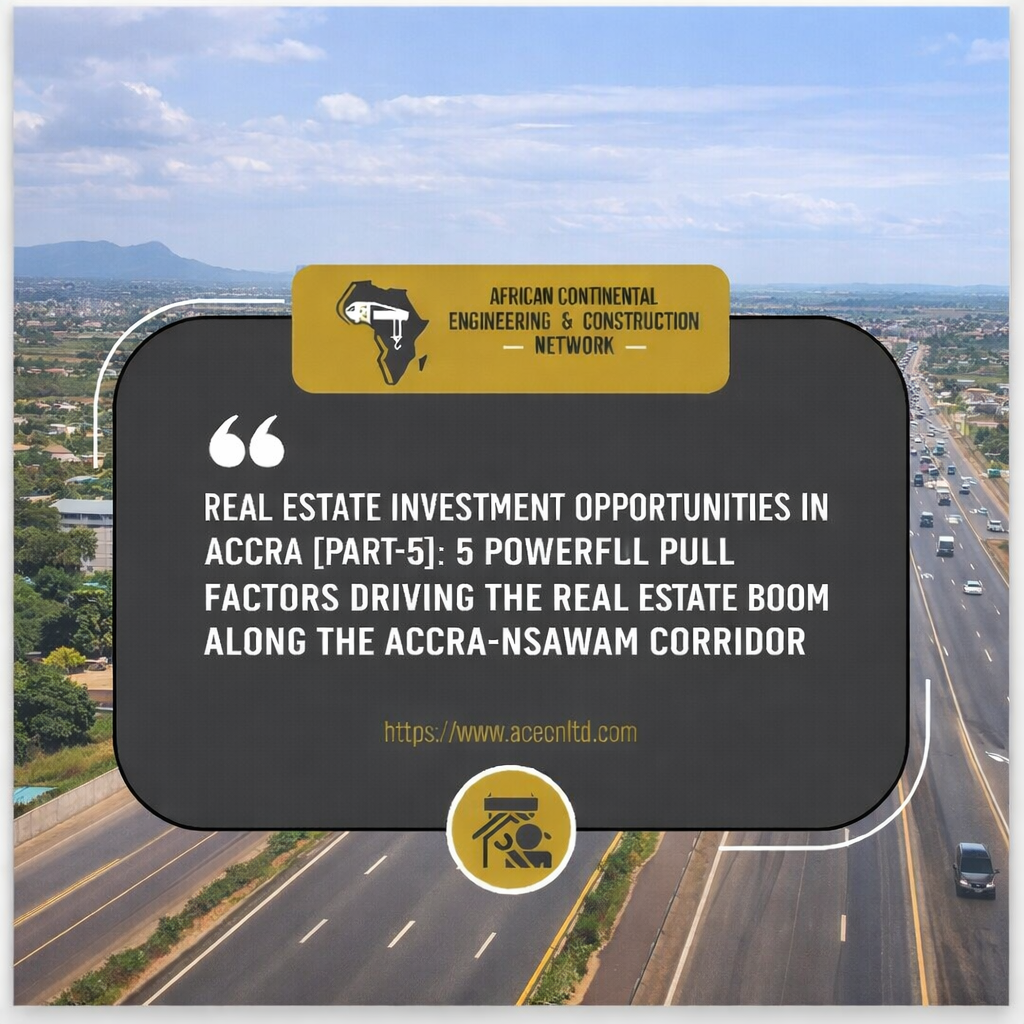
REAL ESTATE INVESTMENT OPPORTUNITIES IN ACCRA [PART-5]: 5 POWERFUL PULL FACTORS DRIVING THE REAL ESTATE BOOM ALONG THE ACCRA-NSAWAM CORRIDOR
Once viewed merely as a commuter stretch linking Greater Accra to the Eastern Region, the Accra–Nsawam corridor is now emerging as one of Ghana’s most dynamic real estate investment frontiers. Driven by ongoing road enhancements and the steady overspill of Accra’s urban growth, this corridor is reshaping investor interest and development patterns at an impressive pace.
Land values are rising, new residential, industrial, logistics and commercial enclaves are taking shape, signaling the rise of a new growth belt. For developers, investors and homebuyers seeking strategic locations with strong appreciation potential, the Accra–Nsawam corridor presents a compelling blend of accessibility, affordability and future-proof opportunity.
But before we go into the substance of today’s discussion, let me remind you that, the Africa Continental Engineering & Construction Network Ltd stands out as one of Ghana’s leading authorities in real estate solutions. From land acquisition, title registration, architectural design, general construction, property development, real estate investment advisory services et cetera, we provide a comprehensive 360ºC service experience.
Ready to move from interest to investment, simply search “Africa Continental Engineering & Construction Network Ltd” on Google. Visit our website, explore available properties and reach out to our team for a swift professional service delivery. With thousands of serviced litigation-free parcels of land across Accra and key growth corridors, we are uniquely positioned to help you unlock value in residential, commercial and industrial real estate. Now get ready as we run you through the real estate investment opportunities on this corridor.
We shall look at 5 pull factors driving real estate investment opportunities on this corridor, explore which type of property investment has high ROI potential and conclude with key risks/challenges and recommendations.
Major National Highway
The Accra-Nsawam corridor (N6) is an inland road that connects Accra to Central Ghana. By architecture, it branched off the N1 in Achimota around the Achimota overpass and heads north through Ofankor to the Eastern Region of Ghana. According to African Development Bank Group (2021), the Accra-Nsawam road (N6) sees about 50,000 vehicular throughputs per day. The report went ahead to mention that “the Ofankor-Nsawam stretch has exceeded its capacity in terms of the average daily traffic volumes”.
What this means essentially is that, the corridor witnesses about 18,250,000 vehicular throughput per annum on the assumption that, all days have equal throughput. This heavy vehicular throughput has attracted major commercial activities along the corridor such as fuel filling stations, spare parts and auto-mechanical shops, food joints, retail shops and Highway Rest Stops such as the likes of LindaDor etc.
Moreover, by virtue of its being the major route through which goods and services move to and fro between the Greater Accra Region, the Eastern Region, the Ashanti and the 3 Northern Regions, it has also attracted many logistics hubs, distribution centres, warehouses, advertising hotspot (billboards) and other transit-orientated developments such as transport terminals, lorry parks and digital-freight zones. This commercial attraction is expanding demand for land, commercial, residential and industrial properties, hence, the corridor now been considered as a real estate investment hotspot.
Strategic Location Advantage
The Accra-Nsawam Corridor serves as strategic industrial/commercial hub between three (3) major consumer markets, the Greater Accra Region, the Eastern Region, the Ashanti Region and the 3 Northern Regions. This makes it easier for factories or warehouses situated along this corridor to quickly supply wholesalers, retailers and supermarkets in the aforementioned Regions.
Because of its strategic location, industrial operators situated along this corridor are able to serve multiple major markets thereby, reducing cost of operation compared to being based deep in Accra or far north. Moreover, this location advantage has also attracted construction firms, building material suppliers, light manufacturing companies etc setting up near Nsawam and distributing/serving their clients along the N6 to Accra, and Nsawam, onward to Kumasi.
The direct highway (N6) access linking Accra, Nsawam and Kumasi reduces delivery times, a significant cost advantage to businesses. This is the reason it is not surprising, to see almost all the big names in the building material input sector such as the Atala Ltd, the K. Ofori’s, the Mississippi Top Ventures, the Paa Niis on this corridor.
Major Stone Quarry Industrial Enclave
Apart from the Tema-Aflao and the Tema-Afienya-Akosombo corridors discussed in earlier editions of this series, the Accra-Nsawam corridor is known to host one of the largest high-density stone quarry industrial enclaves in Ghana, supplying both the Greater Accra and Eastern Regional markets.
The corridor houses key stone quarry operators such as the Maso Quarry, Mansco Quarry, E&H Quarry, Atlantic Rock Quarry, China Railways Engineering Quarry, Quality Quarry, Falcon Quarry, J&A Quarry just to mention a few. The operation of this industrial enclave has also driven the expansion of major industrial activities on the corridor, the demand for heavy-duty equipment rental and sales, haulage and logistics companies, fuel filling stations, spare part shops and auto-mechanical workshops etc. The commercial ripple effect of the operations of this enclave is no doubt one of the pull factors, driving the real estate investment boom along the corridor.
Available Affordable Land
The availability of affordable land along the Accra-Nsawam corridor directly enhances its opportunities by lowering entry barriers and enabling long-term strategic growth for businesses. Lower industrial land cost along the corridor compared to some of the light industrial zones in Tema makes it more attractive to existing and prospective industrial investors. Whilst gathering data for this article, we did a simple survey on land prices between some industrial areas in Accra and those along the Accra-Nsawam corridor.
The results did not come as a surprise though, we discovered that the average price per acre of industrial land in the Tema Light Industrial Zones sells between USD$ 250,000 and USD$ 350,000 or more, whilst similar acreage along the Accra-Nsawam corridor sells between USD$ 8,500 and USD$ 10,000.
Essentially, this suggests that, on average, the amount of money required to acquire 1acre of land in Tema Light Industrial Zone, can acquire 20 acres of same industrial land on the Accra-Nsawam corridor, holding other variables constant. This is the reason why a significant portion of the Accra industrial spillover is also shifting steadily, towards this particular corridor.
The above notwithstanding, the flexibility for large plots, making room for expansion of warehouses, logistics hubs and the less urban congestion that eliminates the Accra traffic bottlenecks, makes the corridor even more attractive. Finally on this particular pull factor, land on this corridor is also a fertile land ideal for high-yield Agricultural production.
For this reason, we have records high of farms, Agri inputs shops, agri-processing infrastructure and the proliferation of farmer stalls on the corridor which is also driving the real estate investment prospects along the stretch. This was supposed to be discussed as a full pull factor though, but we shall leave it here for want of time and space.
Impact of the Pull Factors on Real Estate Investment
Now, having discussed the pull factors, let us delve into the real estate investment opportunities been created by these pull factors. The discussions here will cover land banking investment, industrial, residential, commercial, logistics and agri-real estate investment opportunities.
Land Banking Investments
Taking into cognizance the above pull factors, the corridor offers affordable undeveloped land parcels ideal for medium to long term investment. As the Accra–Nsawam road works progresses, land values are expected to appreciate significantly, driven by improved mobility and increased commercial activity.
This will make property investment in communities along the stretch such as Medie, Pokuase, Amasaman, Sapeiman, Ofankor, Kuntunse etc very lucrative for investors who have already invested and promising for prospective investors nurturing ambitions to invest on this particular corridor.
Many years ago, some smart real estate investors such as the Adom City Estate, Wachild Estate, Peason Properties, Kas Estate etc secured properties along this corridor. One can imagine the return of investment that they stand to rake-in today taking into consideration the prevailing property values along the corridor.
Residential Developments
The presence of the industrial stone quarry enclave, the proliferation of industrial settlements etc has sky-rocketed the demand for social housing to accommodate the industrial workforce moving into the corridor. The growing number of people seeking affordable living outside central Accra as a result of the urban population spillover coupled with the those migrating in to tap into the industrial opportunities on the corridor, also adds up to the demand for structured residential estates and mixed-use developments.
This comes as a huge real estate investment opportunity for prospective investors nurturing plans to invest in this promising corridor. Social housing and mixed-use apartments are in high demand, and demand is likely to triple in the next couple of years after the expressway is completed and commissioned.
However, for those interested in residential real estate investment should be mindful not to situate their properties close to the highway even if the zoning laws permits it. Air and noise pollution from the highway may defeat the purpose and ROI of the investment.
Industrial and Logistics Real Estate
Given the corridor’s strategic location and connection between Greater Accra, the Eastern Region, the Ashanti and the 3 Northern Regions, it is ideal for logistics parks, warehouses, distribution hubs, fuel filling stations, agro-processing infrastructure and light manufacturing facilities.
It is therefore not surprising to see several logistics parks, warehouses, agro-processing facilities, food processing factories, building material distributor warehouses sprung up along the corridor in recent times.
Also, big names in the oil marketing sector such as Goil, Star Oil, Shell, Total Energies, Zen Petroleum, Dukes Petroleum, etc have heavy presence on the corridor. What is even more striking about this phenomenon is that the proliferation is expected to persist unless an effective natural or deliberate disincentive is introduced.
To conclude on this, let me reiterate this point that, the corridor and its surroundings are increasingly attractive for companies priced out of Accra’s congested and expensive industrial zones. This has made private industrial zone investment opportunities in the likes of the Dawa Industrial Zone, the Meridian Industrial Zones etc (initiatives of the LMI Holdings), more promising.
Commercial Real Estate
The mass movement of both industrial and human settlement to the corridor has created a demand for commercial real estate. Demand for shops for building material suppliers, agri-inputs suppliers, auto and spare part shops, retail shops, raw material bays etc are some of the most ideal real estate investment opportunities for those interested in commercial real estate investment.
Apart from the mainstream commercial real estate, agri-real estate such as poultry, piggery, irrigation, greenhouse agriculture, raw material storage infrastructure etc are also promising on this corridor.
Anticipated Challenges
Land Title and Encroachment Issues: Peri urban areas around Accra commonly experience land litigation and multiple claims. Investors must conduct thorough title searches, review cadastral plans, and engage licensed surveyors to mitigate the incidence of litigation.
Road Construction Delays: As it is common with government projects, the Accra–Nsawam project may travel years and transcend governments, therefore, construction timelines may shift. Delays may affect market timing and infrastructure dependent developments etc. But the good news is that return on investment will always be guaranteed.
Gaps in Utilities and Services: Power, water and drainage infrastructure do not always keep pace with real estate growth. Developers may need to invest in boreholes, septic systems, transformers, and internal roads. This should be borne in mind by investors who are interested in developing their properties on the corridor now.
Zoning and Regulatory Uncertainty: Because the corridor remained undeveloped and unregistered land for decades, there are pockets of local planning and zoning irregularities prospective investors must beware of. Investors should confirm land use classifications, building regulations and required permits from local authorities before acquiring properties.
Air Pollution Risks: The heavy vehicular throughput coupled with the industrial settlement on the corridor poses both air and noise pollution risks to humans and other living species. This is key to those interested in residential developments.
Conclusion
In conclusion, the Accra–Nsawam stretch stands out as one of Ghana’s most promising growth corridors. With improved connectivity, expanding human and industrial population spillover, the corridor offers substantial returns for well positioned investors.
Its strategic location, improving infrastructure and access to both urban and peri-urban markets make it ideal for industrial real estate, logistics hubs, agri-real estate and land banking. Whether you are eyeing warehousing, factories, farm estates, mixed-use developments, private industrial zones, this corridor offers a unique blend of affordability, accessibility and growth potential for forward-thinking investors.
References
-
- African Development Bank Group (2021). Ghana: African Development Bank Group-financed road interchange opens; trade and incomes expected to rise. Accessed from https://www.afdb.org/en/news-and-events/press-releases/.
-
- Ghana Highway Authority. (2023). Traffic Volume and Vehicle Classification Report. Accra: GHA.
-
- Lands Commission Ghana. (2023). Land Use and Spatial Planning on Major Growth Corridors in Accra. Accra: Lands Commission.
-
- Graphic Online. (2023, November 15). Real estate expands along Nsawam corridor amid growing industrial activity. Retrieved from https://www.graphic.com.gh/
-
- Prime News Ghana. (2024, March 8). Nsawam-Pokuase Road Expansion to Ease Traffic and Spur Development. Retrieved from https://www.primenewsghana.com/
-
- GhanaWeb. (2023, December 20). Logistics and warehousing zones grow along N6 corridor. Retrieved from https://www.ghanaweb.com/
-
- KPMG Ghana. (2022). Ghana Real Estate Market Snapshot. Accra: KPMG.
-
- Ghana Investment Promotion Centre (GIPC). (2023). Investment Guide – Industrial and Agri-Real Estate Opportunities in Ghana. Accra: GIPC.
Post Views: 162

Leave Your Comment