- +233209032280
- Monday to Friday: 9am to 5pm

LAND BUYING CHECKLIST IN GHANA: A PRACTICAL DUE DILIGENCE GUIDE FOR SAFE LAND ACQUISITION [PART 3] - AFRICA CONTINENTAL ENGINEERING & CONSTRUCTION NETWORK
- Home
- LAND BUYING CHECKLIST IN GHANA: A PRACTICAL DUE DILIGENCE GUIDE FOR SAFE LAND ACQUISITION [PART 3]
20Jan’26
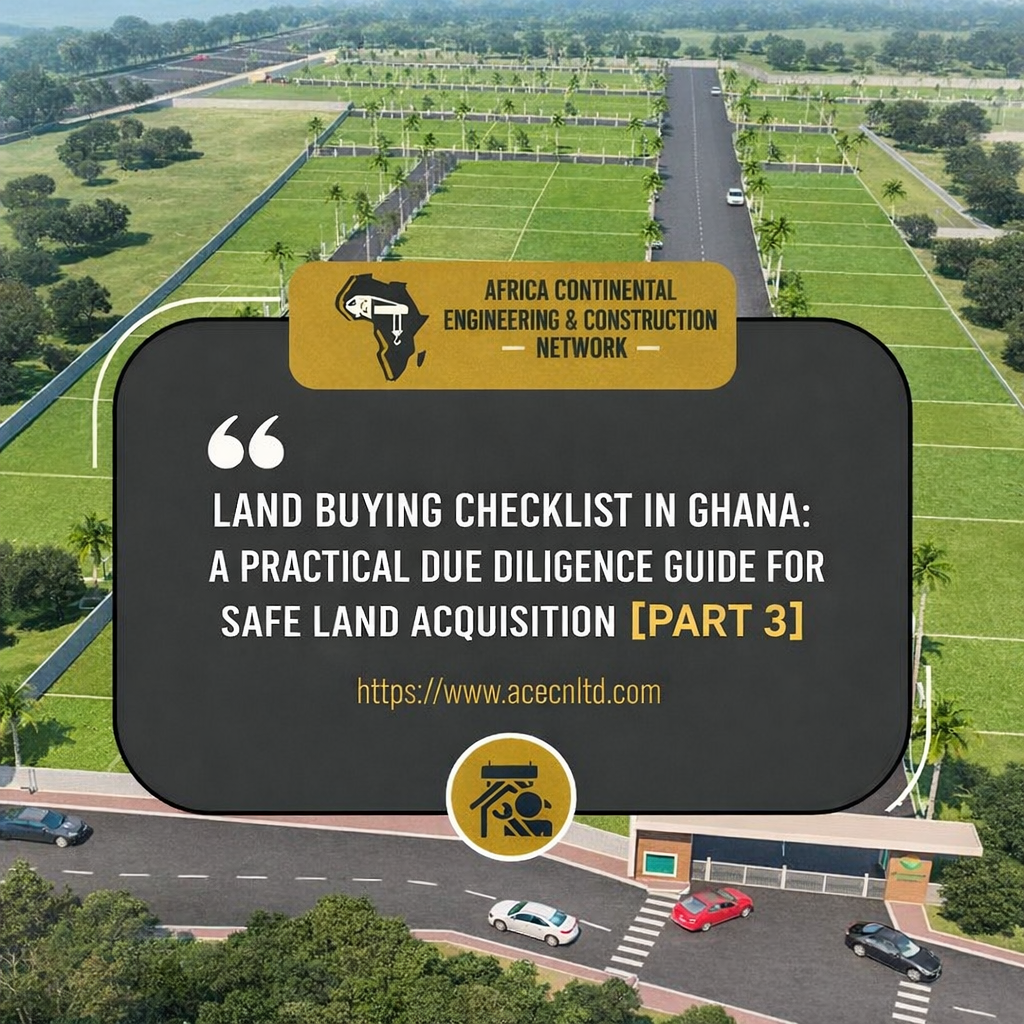
LAND BUYING CHECKLIST IN GHANA: A PRACTICAL DUE DILIGENCE GUIDE FOR SAFE LAND ACQUISITION [PART 3]
By the time a land buyer reaches the transaction stage, confidence is usually high. Ownership has been verified, planning issues appear settled, then the temptation to hurriedly effect payment is often high, but this is where the greatest losses can occur. In Ghana’s land market, many properties do not become problematic at the title authentication stage, they unravel at execution.
Poorly drafted agreements, informal considerations, missing statutory consents and undocumented handovers have quietly turned “good lands” into decades-long legal battles over the years. The land was genuine; the transaction and documentation defective, this is where the mismatch is.
In this Part 3, Transaction and Documentation, we expose the transaction blind spots most buyers underestimate and outline the documentation standards, legal safeguards and procedural discipline required to convert verified land into defensible, bankable property.
But before we go into the nitty-gritty of today’s discussion, let me remind you that, the Africa Continental Engineering & Construction Network Ltd stands out as one of Ghana’s leading authorities in real estate solutions. From land acquisition, title registration, architectural design, general construction, property development, real estate investment advisory services et cetera, we provide a 360ºC service experience.
Ready to move from interest to investment, kindly, explore available properties on our property page and reach out to our team for a swift professional service delivery, with thousands of serviced litigation-free parcels of land across Accra and key growth corridors, we are uniquely positioned to help you unlock value in residential, commercial and industrial real estate.
Transaction and Documentation: The Legal Bedrock of Secure Land Ownership
This is not to underestimate the importance of the initial phases of the land buying due diligence process, but the most decisive moment when legal ownership is either secured or fatally compromised is the Transaction & Documentation Phase. This phase converts intent into enforceable rights and material mistakes here can render even the most rigorous due diligence an exercise of futility.
Today, we shall look at three (3) checklist items, 9, 10 and 11. First, Legal Documentation, second, Payment Structuring and third, Physical Possession and Protection, respectively.
Checklist Item 9: Prepare and Review Legal Documents
Once verification is complete, legal practitioners prepare or review key transaction documents, including the sale agreement, conveyance/indenture, site plan and statutory declarations. These documents define the parties’ rights, payment terms, land description and conditions precedent.
Proper drafting ensures compliance with the provisions of section (207), (208), (209) of Ghana’s Land Act, 2020 (Act 1036) and reduces exposure to fraud, double sales and future litigation. Ultimately, careful legal documentation safeguards the buyer’s interest and facilitates successful registration and title perfection.
In Ghana, land ownership is transferred through a Deed of Assignment (Indenture), which must be prepared by a qualified lawyer pursuant to section 33 of the Land Act, Act 2020 (Act 1036). This instrument establishes the buyer’s proprietary interest and defines the legal boundaries of ownership rights. Professional legal drafting ensures the inclusion of enforceable warranties, indemnities, dispute resolution clauses and compliance with other statutory requirements.
Accurate Land Description and Coordinates
A legally valid deed must precisely describe the land using licensed survey coordinates, boundary bearings and parcel identifiers as required by law subject to section 207 (2)(a) of the Land Act 2020 (Act 1036). Site plans that are not verified or bar-coded by the Lands Commission remain unreliable and prone to duplication, overlap and boundary conflicts.
According to the Lands Commission, cadastral inconsistencies and inaccurate surveys are among the principal drivers of land disputes nationwide (Lands Commission Ghana, 2021). Buyers must therefore engage independent licensed surveyors to ensure the coordinates in their deeds align with official cadastral records.
Clear Consideration (Price) Stated
The purchase price must be clearly stated in the deed, a strict legal requirement as set out in section 163 (2) of the Land Act, Act 2020 (Act 1036). This serves three critical functions: first, establishing enforceability of contract, second, providing a basis for stamp duty and registration assessment of the contract and finally, preventing a future dispute over payment obligations. Ambiguity in consideration clauses weakens contractual certainty and increases litigation exposure.
Execution by All Required Parties
For a deed to be legally binding, it must be properly executed by all parties with legal interest in the land, including spouses, family heads, stool authorities or trustees where applicable as mandated by section 34 of the Land Act, Act 2020 (Act 1036). Failure to secure proper execution invalidates the transaction and exposes buyers to title challenges.
Checklist Item 10: Payment Structure & Evidence
Financial discipline is as important as legal documentation. The majority of land fraud cases in Ghana arise from premature payments, undocumented transactions and informal cash dealings. Buyers must therefore ensure that all payments (considerations) are documented in accordance with section 163 (2) of the Act 1036.
Avoid Full Payment before Documentation
Paying the full purchase price before documentation completion in itself is not an infraction however; such an act removes the buyer’s leverage and creates incentives for default, double allocation or renegotiation. Experts strongly recommend staged payments, tied to milestones such as survey verification, title confirmation and deed execution (Africanvestor, 2025).
The best alternative would have been an explicit legal provision to protect buyers but unfortunately, Ghana does not have such consumer protection legislation, hence the need for one to include escrow provisions in the documentation to protect buyers. This ensures funds are held by a third party and later transferred to the seller after the entire buying process is soundly completed.
Payments Traceable (Bank Transfer Preferred)
Apart from the strict legal requirement on the mode of payment for property transactions in Ghana as set out in section 45(1) of the Real Estate Agency Act, Act 2020 (Act 1047) which states that: “Payment for each real estate transaction shall be by bank draft, cheque, bank transfer or electronic money transfer”, transaction traceability is a legal protection for the buyer and also serves a check against money laundry which is rumored to be prevalent in the real estate sector in Ghana.
Bank transfers provide transaction records admissible in court and verifiable for tax and audit purposes. Buyers are therefore advised to stay away from all forms of incentives to make cash payments as it lacks evidentiary value admissible in the court of law.
Receipts Issued and Acknowledged
Each payment must be supported by formal receipts bearing signatures, dates, transaction purpose and amounts. Receipts provide proof of performance and are essential during registration, dispute resolution or court proceedings.
Consider Escrow or Staged Payments
As stated succinctly earlier, an escrow law would have been the best security for buyers. But the absence of it makes it necessary for informed buyers to insist on their consultants to embed escrow provisions into the property sale documentations to a layer of security to the buyer particularly, in higher-value transactions.
To give a brief architecture of the escrow security, the funds remain with a neutral custodian and are released only upon satisfaction of agreed conditions, ensuring alignment between payment and documentation delivery. The challenge in Ghana however is that, because of the competitive nature of the sector, buyers are most often coerced indirectly into making full payment in their quest to secure the property before the process is soundly completed.
Checklist Item 11: Possession & Site Protection
Possession and site protection mark the point where legal rights meet physical reality. In Ghana’s land market, acquiring valid documents without securing possession and protecting the site leaves ownership exposed to encroachment, trespassing, multiple claims and future disputes. Possession refers to the buyer’s lawful assumption of control over the land after completion of the transaction. This typically includes a formal handover by the grantor, identification of boundaries on site or symbolic physical acts evidencing occupation. Without clear possession, third parties may challenge ownership or opportunistically occupy the land.
Physical Site Possession
Site protection is the proactive safeguarding of the land against trespassers, encroachment and unlawful development. Common measures include boundary demarcation, erection of site markers or fencing, placement of signage, engagement of caretakers where appropriate and periodic site inspections. These actions serve both practical and evidentiary function, demonstrating control and discouraging adverse claims.
In Ghana, where land is often vacant for extended periods, failure to take possession and protect the site can undermine even properly documented acquisitions. In essence, possession and site protection consolidate ownership on the ground. They translate paper rights into visible control, preserve the integrity of the land and significantly reduce the risk of future litigation.
Conclusion
In conclusion, this Phase 3 is where land acquisition succeeds or collapses. Legal documentation without accuracy is defective. Payment without traceability is vulnerable. Ownership without possession is insecure. Therefore, prospective land buyers; individuals, developers and institutional investors alike must approach this phase with; legal precision, financial discipline, physical enforcement and institutional compliance. When properly executed, Phase 3 converts land acquisition from a speculative gamble into a secure, bankable and development-ready asset, aligning with Ghana’s broader land administration reforms under the Land Act, 2020 (Act 1036).
But before we part, do note that information provided in this article or any article by this writer is the opinions or views of the writer for general education purposes and does not constitute professional or legal advice. Readers are therefore advised to consult certified professionals/consultants before making any legally binding decision or any commitment that has financial implications. Stay tuned for the final part, Part 4, which will be on Post-Purchase Perfection.
References
-
- Africanvestor. (2025). Ghana property buying process: Step-by-step guide. https://theafricanvestor.com/blogs/news/ghana-property-buying-process
-
- Clinton Consultancy. (2025). Due diligence before buying land in Ghana: A legal guide. https://clintonconsultancy.com/2025/08/28/land-due-diligence-ghana/
-
- Judicial Service of Ghana. (2020). Annual report of the Judicial Service of Ghana. https://judicial.gov.gh/index.php/publications/annual-reports
-
- Lands Commission Ghana. (2021). Land administration and title registration in Ghana. https://landscommission.gov.gh
-
- MyJoyOnline. (2025). Advice to investors: Practical due diligence to acquisition of real estate in Ghana.https://www.myjoyonline.com/advice-to-investorspractical-due-diligence-to-acquisition-of-real-estate-in-ghana/
- Approximately 90 % of Ghanaian court cases relate to land disputes — Legal Ink (Legal Ink; May 8, 2024. https://www.legalinkonline.com/approximately-90-of-ghanaian-court-cases-relate-to-land-disputes/
Author
Daniel Kontie
Chief Executive Officer
Africa Continental Engineering & Construction Network Ltd
Email: d.kontie@acecnltd.com
Contact: +233209032280
Daniel Kontie
Chief Executive Officer
Africa Continental Engineering & Construction Network Ltd
Email: d.kontie@acecnltd.com
Contact: +233209032280
Post Views: 2,099


Contact Details
- Accra Tema comm 26
- info@acecnltd.com
- +233 20 903 2280
© 2026 reserved AFRICAN CONTINENTAL ENGINEERING CONSTRUCTION NETWORK
Leave Your Comment