- +233209032280
- Monday to Friday: 9am to 5pm

LEGAL AND INSTITUTIONAL WEAKNESSES IN GHANA’S REAL ESTATE SECTOR [PART 10]: HOW WEAK COORDINATION BETWEEN CUSTOMARY LAND GOVERNANCE AND STATUTORY LAND ADMINISTRATION SYSTEMS IS DRIVING LAND LITIGATION AND UNDERMINING REAL ESTATE DEVELOPMENT - AFRICA CONTINENTAL ENGINEERING & CONSTRUCTION NETWORK
- Home
- LEGAL AND INSTITUTIONAL WEAKNESSES IN GHANA’S REAL ESTATE SECTOR [PART 10]: HOW WEAK COORDINATION BETWEEN CUSTOMARY LAND GOVERNANCE AND STATUTORY LAND ADMINISTRATION SYSTEMS IS DRIVING LAND LITIGATION AND UNDERMINING REAL ESTATE DEVELOPMENT
14Apr’26
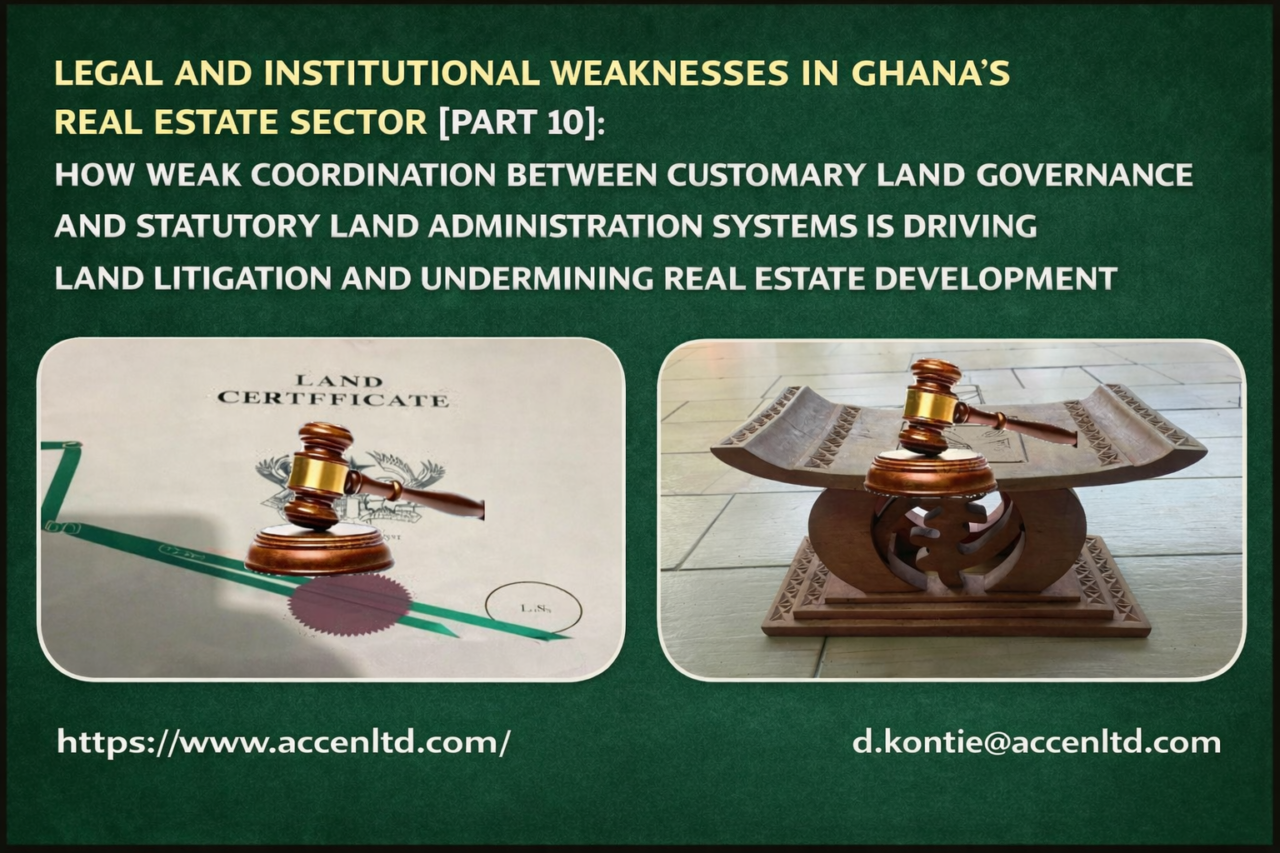
LEGAL AND INSTITUTIONAL WEAKNESSES IN GHANA’S REAL ESTATE SECTOR [PART 10]: HOW WEAK COORDINATION BETWEEN CUSTOMARY LAND GOVERNANCE AND STATUTORY LAND ADMINISTRATION SYSTEMS IS DRIVING LAND LITIGATION AND UNDERMINING REAL ESTATE DEVELOPMENT
Across Ghana’s rapidly expanding urban and peri-urban landscapes, thousands of acres of land are locked in disputes, stalled developments and protracted litigation. In cities such as Accra, Kumasi and Takoradi, it is not uncommon to find partially completed buildings abandoned for years due to competing ownership claims, overlapping allocations, or unresolved litigation over land titles. Investors frequently discover that land legitimately acquired from a traditional authority cannot be registered with the statutory land administration system because the same parcel has already been allocated to another party, is under litigation, or lacks proper documentation within the state system.
These recurring challenges are not merely isolated incidents of fraud or negligence; rather, they reflect deeper structural weaknesses within Ghana’s land governance architecture, particularly the weak coordination between customary land governance system and statutory land administration institution. The consequences of this institutional disconnect are profound. It escalates land litigation, declining investor confidence, rising transaction costs and significant delays in real estate development.
This article focuses on institutional arrangements and governance failures that continue to undermine land administration efficiency, especially, how weak coordination between customary land authorities and statutory land administration institutions that fuels land disputes and litigation in Ghana. It further explores the implications for the real estate sector and the broader economy and finally, proposes a practical framework for strengthening institutional collaboration in land Ghana’s land governance architecture.
But before we go into the details of today’s discussion, let me remind you that, the Africa Continental Engineering & Construction Network Ltd stands out as one of Ghana’s leading real estate developers and consultants. From land acquisition, title registration, architectural design, general construction, property development, real estate investment advisory services et cetera, we provide a 360ºC service experience.
If you are ready to move from interest to investment, simply search “Africa Continental Engineering & Construction Network Ltd” on Google. Visit our website, explore available properties and reach out to our team for a swift professional service delivery.
With thousands of serviced litigation-free parcels of land across Accra and key growth corridors, we are uniquely positioned to help you unlock value in residential, commercial and industrial real estate. Now, let us go into the nitty-gritty of the discussion by establishing the structural context ofCustomary and Statutory Land Administration systems in Ghana.
Understanding Ghana’s Dual Land Administration Structure
Ghana’s land tenure system is characterized by a dual structure involving customary land ownership and statutory land administration. Approximately, 80 percent of land in Ghana is held under customary ownership, managed by stools, skins, families and traditional authorities (National Land Policy, 1999).
Traditional leaders act as custodians of these lands on behalf of their communities and play a central role in allocating land rights to individuals and developers. At the same time, statutory institutions, particularly the Lands Commission are responsible for land registration, title certification, surveying and maintaining official land records under the framework of the Land Act 2020 (Act 1036).
In theory, these two systems are expected to complement each other. Customary authorities allocate land while statutory institutions formalize and register the rights created through these allocations. However, in practice, coordination between these systems is often weak, fragmented, and poorly structured. Scholarly research on Ghana’s land governance consistently highlights the complexity arising from this dual structure and the institutional gaps between customary and statutory systems (Chigbu & Ansah, 2020; Ubink & Quan, 2008). These gaps create fertile ground for disputes, overlapping allocations and protracted legal conflicts.
How Weak Institutional Coordination Drives Land Litigation
Weak institutional coordination remains one of the most critical yet under-examined drivers of land litigation in Ghana. The fragmented interaction between key actors, such as the Lands Commission, customary authorities, local government bodies and the judiciary creates overlapping mandates, inconsistent records and procedural inefficiencies that fuel disputes rather than resolve them.
In the absence of a harmonized and interoperable land administration system, multiple claims to the same parcel of land often emerge. This undermines tenure security and investor confidence. Below is how these institutional disconnects not only perpetuate legal conflicts but also stall development and weaken the overall credibility of the land governance framework.
Multiple Allocations of the Same Parcel of Land: One of the most common sources of land litigation in Ghana arises when the same parcel of land is allocated to multiple buyers. This often occurs because customary authorities allocate land without a synchronized system that verifies whether the land has already been registered or encumbered within the statutory system.
Without effective data integration between traditional land custodians and statutory registries, it becomes difficult to verify prior interests in land before new allocations are made. Consequently, competing ownership claims frequently emerge, leading to lengthy litigation.
Poor Documentation and Record-Keeping within Customary Systems: Another structural problem lies in the limited documentation and record-keeping practices within some customary land management systems. Many traditional authorities allocate land based on oral agreements or informal documentation that may not meet the legal standards required for statutory registration.
Studies evaluating Customary Land Secretariats in Ghana found that many lacked effective record management systems and had difficulties maintaining accurate transaction records (Akwensivie, 2022). This documentation gap creates uncertainty when buyers attempt to formalize their interests through statutory registration.
Institutional Fragmentation within the Land Administration System: Even within the statutory system, institutional fragmentation has historically complicated land administration processes. Although reforms have consolidated several agencies into the Lands Commission, coordination challenges between surveying, registration, valuation and planning functions continue to affect the efficiency of land administration.These inefficiencies create administrative bottlenecks that delay title registration and increase opportunities for disputes.
Weak Integration of Customary Authorities into Formal Land Governance: Traditional authorities control the majority of Ghana’s land resources, yet their integration into formal land administration processes remains limited. Policy discussions involving institutions such as the National House of Chiefs have repeatedly emphasized the need for stronger collaboration between chiefs and statutory agencies in land governance, (Lands Commission, 2024). Until institutional mechanisms that formally integrate customary authorities into statutory land administration processes are put in place, coordination challenges will persist.
Implications for the Real Estate Sector
Escalating Land Litigation: Land disputes constitute a significant proportion of civil cases in Ghanaian courts. Protracted litigation over land ownership creates uncertainty around property rights and slows the pace of real estate development.The Lands Commission itself acknowledges that land disputes remain widespread and has introduced Alternative Dispute Resolution mechanisms to manage the high volume of cases, (Lands Commission, 2025).
Rising Transaction Costs for Property Developers: Developers are increasingly forced to conduct extensive due diligence before acquiring land. These processes often involve multiple legal searches, negotiations with traditional authorities and verification through statutory institutions, all of which increase transaction costs and project timelines.
Reduced Investor Confidence: Investors prioritize markets with secure property rights and predictable land administration systems. Persistent land disputes and registration delays weaken Ghana’s competitiveness as a real estate investment destination.According to the World Bank, secure land tenure is a prerequisite for attracting investment and enabling sustainable urban development (World Bank, 2003).
Slowed Urban Development and Housing Delivery: Land disputes often delay or halt major housing and infrastructure projects. This undermines efforts to address Ghana’s housing deficit and slows urban economic growth.The UN‑Habitat has consistently emphasized that efficient land governance systems are essential for sustainable urban development (UN-Habitat, 2015).
A Practical Framework for Strengthening Institutional Coordination
Addressing these challenges requires structural reforms that bridge the gap between customary land governance and statutory land administration.
Digitization and Integration of Customary Land Records: A national land information system should integrate customary land records with statutory land databases to enable real-time verification of land allocations.
Strengthening Customary Land Secretariats: Customary Land Secretariats must be strengthened with professional land administration support, improved record management systems and standardized documentation procedures.
Institutionalized Collaboration between Traditional Authorities and State Agencies: Regular institutional coordination mechanisms should be established between traditional authorities, the Lands Commission and metropolitan planning authorities to improve information sharing.
Mandatory Pre-Allocation Land Verification: Before land is allocated by customary authorities, verification should be conducted through statutory databases to confirm that the land is free from prior registration or litigation.
Expansion of Alternative Dispute Resolution Mechanisms: Land disputes should be resolved through structured mediation frameworks before escalating to formal court litigation, in line with provisions under the Land Act 2020 (Act 1036).
Conclusion
Ghana’s land governance system sits at the intersection of tradition and modern state administration. While customary authorities remain the custodians of the majority of the country’s land resources, statutory institutions provide the legal infrastructure for securing property rights.
However, weak coordination between these two systems continue to generate land disputes, fuel litigation and undermine the efficiency of the real estate sector. Without deliberate institutional reforms to integrate customary and statutory land administration processes, Ghana risks perpetuating a cycle of land conflicts that constrain real estate development and weakens investor confidence.
Strengthening coordination between customary authorities and statutory land administration institutions is therefore not merely an administrative necessity, but a strategic imperative for unlocking the full potential of Ghana’s land resources and supporting sustainable economic development.
References
- Government of Ghana (2020). Land Act, 2020 (Act 1036). https://lawsghana.com/pre_1992_legislation/land-act-2020-act-1036/
- Ministry of Lands and Natural Resources (1999). National Land Policy. https://mlnr.gov.gh
- Ubink, J., & Quan, J. (2008). How to Combine Tradition and Modernity? Regulating Customary Land Management in Ghana. Land Use Policy. https://doi.org/10.1016/j.landusepol.2007.06.002
- UN-Habitat (2015). Land Tenure Security and Sustainable Urban Development.https://unhabitat.org
- Lands Commission. (2025). National Land Policy Review engagement held with Standing Committee of National House of Chiefs in Kumasi. https://www.lc.gov.gh/2025/07/14/national-land-policy-review-engagement-held-with standing-committee-of-national-house-of-chiefs-in-kumasi/
- Lands Commission. (2024). Lands Commission strengthens land dispute resolution with ADR training for staff. https://www.lc.gov.gh/2024/10/02/lands-commission-strengthens-land-dispute-resolution-with-adr-training-for-staff/
- Akwensivie, G. A. (2022). Appraisal of Thirty-Three Customary Land Secretariats in Ghana. African Journal of Land Policy and Geospatial Sciences. https://doi.org/10.22004/ag.econ.334506
About Author
Daniel Kontie is a young enthusiastic Ghanaian Entrepreneur, the Executive Chairman of the Africa Infrastructure Group; comprising the Africa Continental Engineering & Construction Network Ltd (ACECN), Falcon 48 Developers; Africa Infrastructure Energy and Africa Land Banking Investment Ltd. All these are infant establishments, disrupting the conventional way of brand building across the African Continent. Daniel is a columnist, a writer and a member of the Ghana Built Environment Writers Association. He can be contacted via Tel: +233209032280; Email: d.kontie@acecnltd.com; Website: https://acecnltd.com/
Post Views: 860


Contact Details
- Accra Tema comm 26
- info@acecnltd.com
- +233 20 903 2280
© 2026 reserved AFRICAN CONTINENTAL ENGINEERING CONSTRUCTION NETWORK
Leave Your Comment