- +233209032280
- Monday to Friday: 9am to 5pm

GHANA’S LAND OWNERSHIP CRISIS: CAN BLOCKCHAIN TECHNOLOGY BE THE GAME CHANGER - AFRICAN CONTINENTAL ENGINEERING & CONSTRUCTION NETWORK
- Home
- GHANA’S LAND OWNERSHIP CRISIS: CAN BLOCKCHAIN TECHNOLOGY BE THE GAME CHANGER
05Apr’26
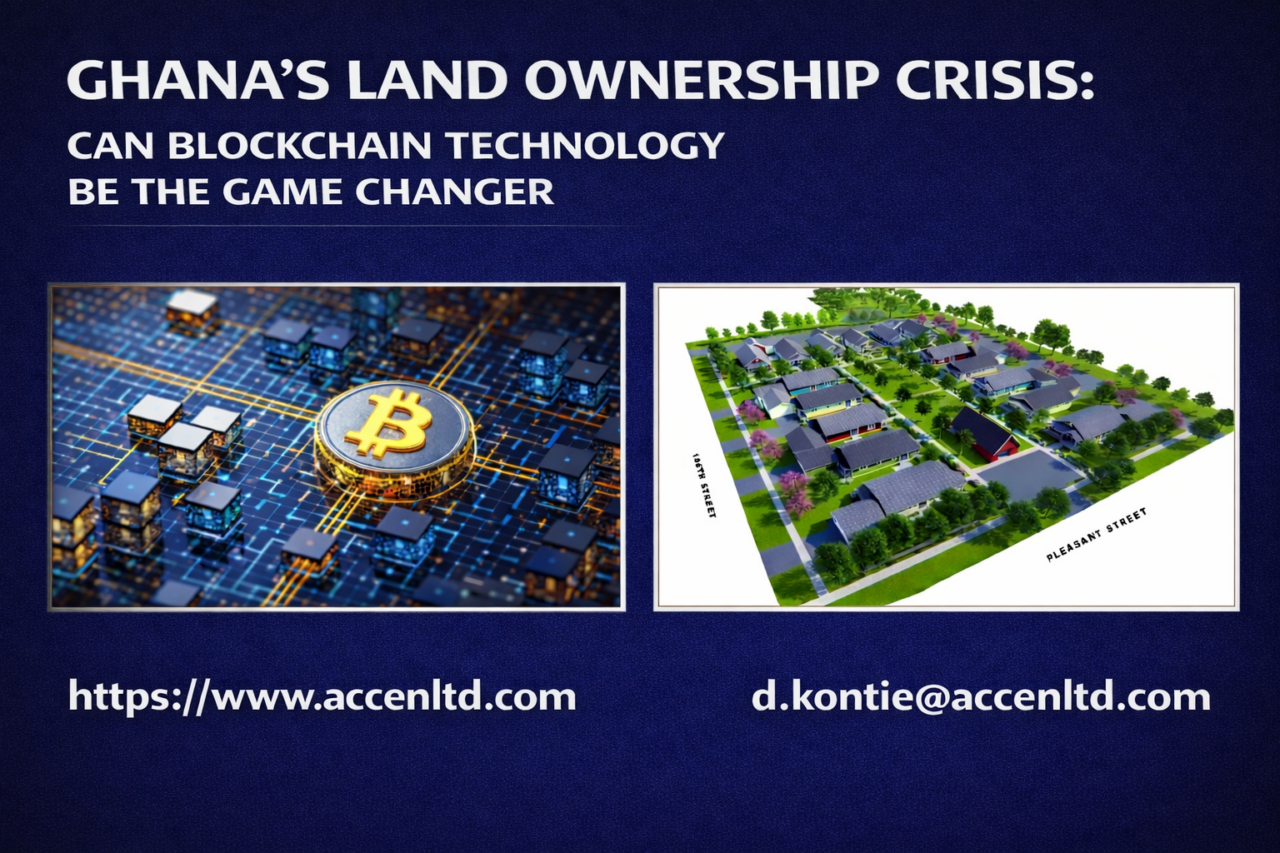
GHANA’S LAND OWNERSHIP CRISIS: CAN BLOCKCHAIN TECHNOLOGY BE THE GAME CHANGER
For decades, land ownership disputes have remained one of the most persistent risks in Ghana’s real estate sector. Investors, developers, financial institutions and ordinary citizens frequently encounter challenges such as multiple sales of the same land, fraudulent documentation, inconsistent ownership records and prolonged litigation.
These problems have not only slowed real estate development but have also undermined investor confidence in Ghana’s property market. The economic implications are significant. Land disputes can stall infrastructure projects, delay housing delivery and discourage long-term investment.
In an effort to address these challenges, Ghana has undertaken several reforms in land administration.
The consolidation of land legislation under the Land Act, 2020 (Act 1036) and the ongoing digitization initiatives by the Lands Commission represent important steps toward improving land governance. Despite these reforms however, structural challenges within Ghana’s land administration system persist.
Fragmented record-keeping, overlapping institutional mandates, customary land tenure complexities and weak verification systems continue to create vulnerabilities within the land market. It is against this backdrop that Blockchain technology is increasingly attracting global attention as a potential tool for transforming land administration systems.
The question policymakers must now confront is whether Blockchain could realistically help address Ghana’s land ownership challenges, or whether the technology risks being seen as a solution to problems that are fundamentally institutional, rather than technological. This article examines whether Blockchain technology can offer a viable solution to Ghana’s persistent land ownership challenges, which continue to undermine real estate development and investor confidence.
It explores the nature and causes of land disputes in Ghana, highlights ongoing reforms such as the Land Act, 2020 (Act 1036) and assesses the potential of Blockchain to improve transparency, reduce fraud and strengthen land administration systems. Drawing on global experiences and local realities, the article further interrogates the limitations of technology in the absence of strong institutions and outlines the key preconditions required for any successful adoption of Blockchain within Ghana’s land governance framework.
But before we go into the details of today’s discussion, let me remind you that, the Africa Continental Engineering & Construction Network Ltd stands out as one of Ghana’s leading real estate developers and consultants. From land acquisition, title registration, architectural design, general construction, property development, real estate investment advisory services et cetera, we provide a 360ºC service experience.
If you are ready to move from interest to investment, kindly search on Google, “Africa Continental Engineering & Construction Network Ltd”, visit the property page, explore available properties and reach out to our team for a swift professional service delivery. With thousands of serviced litigation-free parcels of land across Accra and key growth corridors, we are uniquely positioned to help you unlock value in residential, commercial and industrial real estate. Now, let us go into the substantive issues, starting with understanding Blockchain technology.
Understanding Blockchain Technology
Blockchain technology is essentially a decentralized digital ledger that records transactions across multiple computers in a way that makes the records extremely difficult to alter once they are entered. Unlike traditional databases that are controlled by a central authority, Blockchain systems distribute data across a network of participants. Every transaction added to the ledger is time-stamped and linked to previous entries, creating a secure and transparent chain of records.
According to the World Bank, b\Blockchain technology has the potential to improve transparency, reduce fraud and enhance trust in record-keeping systems (World Bank, 2019). Applied to land administration, Blockchain could fundamentally transform how property rights are recorded, verified and transferred.
Why Blockchain Matters in Land Administration
Land administration systems rely heavily on accurate record-keeping and the ability to verify ownership histories. In many developing countries, however, land records are often fragmented, incomplete or vulnerable to manipulation just as it is in Ghana’s situation. A Blockchain-based land registry could introduce several improvements.
First, every land transaction could be permanently recorded on a tamper-resistant digital ledger, making it extremely difficult to alter historical records without leaving a transparent footprint.
Second, the ownership history of a property could be verified instantly, reducing the time required for due diligence during land transactions.
Third, Blockchain could significantly reduce the risk of document manipulation and title fraud, which are among the leading causes of land disputes in Ghana.
Fourth, the system could make multiple sales of the same land far more difficult, as each transaction would be publicly traceable on the ledger and online.
Finally, Blockchain could streamline property verification processes for investors, banks and regulators. In such a system, trust would shift from individuals and paper documentation to a transparent technological infrastructure.
Potential Impact for Ghana
If properly implemented, Blockchain-based land registries could help address several long-standing weaknesses within Ghana’s property market. These include, weak land record management, conflicting ownership claims, lengthy verification processes, delays in property registration, investor uncertainty in land transactions. Improving these systems would not only reduce litigation but could also unlock greater investment in Ghana’s real estate sector.
The United Nations Economic Commission for Europe notes that, secure land administration systems are essential for economic development because they enable property to be used as collateral for financing and investment (UNECE, 2019). In Ghana, where land disputes remain common, strengthening the credibility of land records could have significant economic benefits.
Lessons from Countries Experimenting with Blockchain Land Registries
Several countries have already begun experimenting with Blockchain-supported land registries. One of the most widely cited examples is Georgia, where the national land registry partnered with Blockchain technology firms to record property transactions on a Blockchain platform. The initiative significantly improved transparency and reduced the time required for property verification.
Similarly, Sweden launched pilot programs exploring Blockchain-based property transaction systems aimed at reducing fraud and improving transaction efficiency. These initiatives demonstrate that Blockchain can enhance trust, transparency and efficiency in property transactions when properly integrated into existing land administration systems. However, they also highlight an important lesson, that is, technology works best when built upon already functional land governance systems.
Why Technology alone cannot Solve Ghana’s Land Challenges
While Blockchain offers exciting possibilities, it is important to recognize that technology alone cannot resolve the structural complexities of Ghana’s land sector. Land administration in Ghana involves both statutory and customary systems. Approximately 80 percent of land in Ghana is held under customary ownership, often administered by stools, skins, families and traditional authorities.
These arrangements create unique governance challenges that technology alone cannot easily resolve. For Blockchain systems to function effectively in Ghana’s land sector, several critical conditions must first be satisfied.
Conditions Required for Successful Blockchain Land Registries
Accurate Baseline Land Records: Blockchain systems can secure existing records, but they cannot correct inaccurate or conflicting records already in the system. Without reliable baseline land data, digitizing records on Blockchain could simply preserve existing inaccuracies.
Strong Institutional Coordination: Land administration in Ghana involves multiple institutions, including the Lands Commission, traditional authorities and local government bodies. Effective Blockchain implementation would require strong coordination among these institutions.
Legal Recognition of Digital Land Records: A blockchain land registry would require clear legal recognition under Ghanaian law. The current legal framework under the Land Act, 2020 (Act 1036) would likely require amendments or regulatory guidelines or an Executive Instrument (LI) to accommodate Blockchain-based records as legally recognized land titles.
Integration with Existing Land Administration Systems: Blockchain technology must integrate seamlessly with existing cadastral mapping systems, property registration processes and land dispute resolution mechanisms. Without such integration, Blockchain risks becoming merely an additional technological layer over an already complex and error-ridden system.
Policy Question for Ghana
The most important question facing policymakers is not whether Blockchain technology works, but rather, the critical question is whether Ghana’s land governance institutions are ready to adopt a technology that demands transparency, accuracy and accountability. Blockchain can strengthen systems that already function reasonably well. But where institutional weaknesses remain unresolved, technology may struggle to deliver the expected results.
For Ghana, the challenge therefore lies not only in adopting innovative technologies but also in strengthening the governance structures that support a Blockchain-based land administration.
Conclusion
Land disputes have long been one of the most serious barriers to real estate development and investment in Ghana. While reforms such as the Land Act, 2020 (Act 1036) and the digitization efforts of the Lands Commission represent significant progress, deeper structural challenges still remain within the land administration system.
Blockchain technology offers promising possibilities for improving transparency, reducing fraud and strengthening property rights. However, as mentioned earlier, technology alone cannot solve Ghana’s land ownership challenges. Successful implementation will require accurate land records, strong institutions, legal reforms and effective integration with existing land governance frameworks.
If these conditions are met, Blockchain could become a powerful tool for transforming land administration in Ghana. The real question for policymakers and industry stakeholders is whether the country is ready to embrace the transparency and institutional reforms that such technology demands.
References
- Deininger, K., & Selod, H. (2019). The Land Governance Assessment Framework. World Bank. https://www.worldbank.org/en/topic/land
- Kasanga, K., & Kotey, N. (2001). Land Management in Ghana: Building on Tradition and Modernity. International Institute for Environment and Development.https://www.iied.org
- Lantmäteriet. (2017). The Land Registry in the Blockchain: Pilot Project Report.https://www.lantmateriet.se
- Republic of Ghana. (2020). Land Act, 2020 (Act 1036).https://landscommission.gov.gh
- United Nations Economic Commission for Europe (UNECE). (2019). Blockchain in Land Administration.https://unece.org/housing/land-management
- World Bank. (2019). Blockchain and Distributed Ledger Technology in Land Administration.https://www.worldbank.org
About Author
Daniel Kontie is a young enthusiastic Ghanaian Entrepreneur, the Executive Chairman of the Africa Infrastructure Group; comprising the Africa Continental Engineering & Construction Network Ltd (ACECN), Falcon 48 Developers; Africa Infrastructure Energy and Africa Land Banking Investment Ltd. All these are infant establishments, disrupting the conventional way of brand building across the African Continent. Daniel is a columnist, a writer and a member of the Ghana Built Environment Writers Association. He can be contacted via Tel: +233209032280; Email: d.kontie@acecnltd.com; Website: https://acecnltd.com/

Leave Your Comment