- +233209032280
- Monday to Friday: 9am to 5pm

REAL ESTATE INVESTMENT OPPORTUNITIES IN ACCRA [PART-6]: 4 KEY FACTORS DRIVING REAL ESTATE INVESTMENT GROWTH ON THE ACCRA-WINNEBA CORRIDOR - AFRICAN CONTINENTAL ENGINEERING & CONSTRUCTION NETWORK
- Home
- REAL ESTATE INVESTMENT OPPORTUNITIES IN ACCRA [PART-6]: 4 KEY FACTORS DRIVING REAL ESTATE INVESTMENT GROWTH ON THE ACCRA-WINNEBA CORRIDOR
20Dec’25
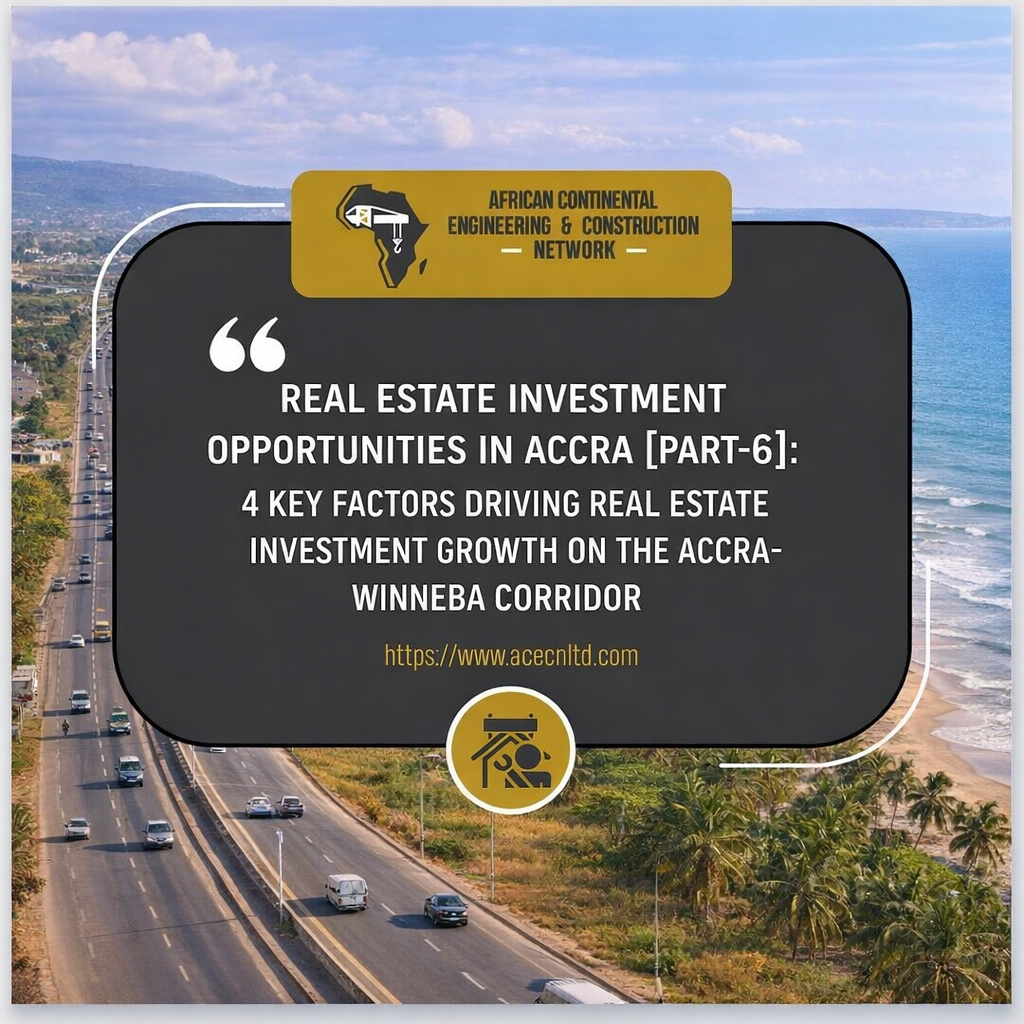
REAL ESTATE INVESTMENT OPPORTUNITIES IN ACCRA [PART-6]: 4 KEY FACTORS DRIVING REAL ESTATE INVESTMENT GROWTH ON THE ACCRA-WINNEBA CORRIDOR
In Ghana’s evolving real estate market, fortune is quickly shifting to the corridors once overlooked. One such game-changing stretch is the Accra–Winneba corridor, a rising powerhouse along the N1 Highway. What was once a quiet coastal link is now transforming into a strategic real estate belt, driven by rapid infrastructure upgrades, urban sprawl and investor interest across residential, commercial, industrial and agri-based developments.
This article reveals how the 4 key driving factors are impacting real estate investment prospects along this corridor, explores the type of property investment with high prospects, and concludes with key risks and recommendations.
But before we go into the substance of today’s discussion, let me remind you that, the Africa Continental Engineering & Construction Network Ltd stands out as one of Ghana’s leading authorities in real estate solutions. From land acquisition, title registration, architectural design, general construction, property development, real estate investment advisory services et cetera, we provide a comprehensive real estate service experience.
Ready to move from interest to investment, simply search “Africa Continental Engineering & Construction Network Ltd” on Google. Visit our website, explore available properties and reach out to our team for a swift professional service delivery.
With thousands of serviced litigation-free parcels of land across Accra and key growth corridors, we are uniquely positioned to help you unlock value in residential, commercial and industrial real estate. Now get ready as we run you through the real estate investment opportunities on the Accra-Winneba corridor, starting with location advantage and strategic connectivity.
Location Advantage and Strategic Connectivity
The Accra-Winneba corridor links the Greater Accra Region to emerging urban centers in the Central Region such as Kasoa, Winneba and beyond. Using Accra as the reference point, the Accra-Winneba corridor forms the western segment of the N1 highway, a critical artery facilitating trade, travel and logistics between Accra, the Central and Western Regions.
Its strategic connectivity and proximity to the coast enhances its attraction to real estate property investment. The expression of which is found in the substantial growth in residential and commercial developments in communities along the corridor. Among these commercial and residential developments are the West Hills Mall, the China Mall and one of Ghana’s leading developers, the Eden Heights.
Available Affordable Land
The availability of affordable lands reduces the initial capital requirements allowing first time investors to participate. This enables developers acquire larger parcels for residential, commercial, industrial or mixed-use developments. Compared to corridors such as the Tema Community 25, the Tema-Akosombo, the Accra-Nsawam, the Accra-Oyibi, the Accra-Aburi stretches, etc, where a serviced plot (70ftx100ft) sells averagely above Ghs 100,000, same along the Accra-Winneba corridor particularly Kasoa and Budumburam area sells around Ghs 30,000 or a little more.
Moreover, the land along the corridor is not only ideal for real estate investment; it is also fertile for agricultural production and its associated developments such as agri-proccessing plants, irrigation infrastructure, which are also springing up on the corridor in record numbers.
Transportation Hub
The corridor is a major transportation hub that links the Greater Accra Region, the Central and the Western Regions of Ghana and through to the border of Ivory Coast at Elubo. This makes it one of the busiest corridors of our national highways. In fact, the Business Funding-Insider (2008) reported that, the Accra-Winneba (N1) stretch sees about 10,000 vehicular throughputs per day.
This means that about 3,650,000 vehicles plough this route per annum on the assumption that throughput is same for all days throughout the 365 days in the year. This places the corridor second, after the Accra-Nsawam (N6) corridor on the list of corridors with high vehicular throughputs per year.
This is 17 years down the line, now with population increases and rising urban sprawl over the period, this figure is expected to have risen even more than double. The constant vehicular and human traffic enhances the attractiveness of nearby land and real estate properties, creating value for transit-oriented developments, hostels, rests stop, auto-mechanic workshops, fuel filling stations, logistics hubs, construction equipment depots and building material depots. This explains why there is a major expansion in the aforementioned developments over the years with many still springing up at increasing rate.
Kasoa Inter-Regional Market
The Kasoa market along the Accra-Winneba corridor is one of the largest and busiest urban markets in the Central Region and the Greater Accra periphery. It serves tens of thousands of traders and buyers daily. Whilst we were gathering information on the Kasoa market for the purpose of this article, we found an estimated footfall (number of people passing through per time) of about 10,000 to 30,000 people on regular days and 30,000 to 50,000 people on peak market days.
This drives the demand for commercial, residential and industrial properties such as retail spaces, warehouses, social housing etc in Kasoa and major towns along the Accra-Winneba corridor.
Impact of Drivers on Real Estate Investment
Even though the investment drivers are few, their impact on multiple levels of real estate investment is enormous. We shall discuss them into detail starting with land banking investment opportunities.
Land Banking Investments
The prospects of land banking along this corridor are great for the following reasons; first, rapid urban expansion. Accra’s urban sprawl is extending partly toward Kasoa, Buduburam, Apam and Winneba. This trend creates increasing demand for land, raising future resale value. Also, the low entry cost of land along the corridor is another compelling factor driving the prospects of land banking investment especially in areas such as Kasoa.
Moreover, the N1 highway expansion, the proposed Kasoa–Winneba highway dualization and the growth in industrial hubs along the corridor are increasing settlement demand. This drives interest in surrounding lands for housing, services and retail centers. Key profitable land banking zones to focus on are, Kasoa, Ngleshie Amanfro, Buduburam, Ojobi.
Residential Development Potential
The impact of the industrial spillover coupled with the prohibitive rents in central Accra; many low-income earners are moving into this corridor in search for affordable accommodation.
This makes the residential real estate investment prospects particularly for social housing more promising than ever. Institutional developers such as Adom City Estate, Bluerose Estate, Ahenfie Estate, Royal Nannies Estate etc have tapped into this demand over the years.
Logistics and Light Industrial Hubs
Due to the strategic location connecting the Greater Accra, Central and Western Regional markets, logistics and warehousing investors are exploring the corridor for light industrial parks, storage and distribution centers.
These opportunities have attracted both heavy and light manufacturing firms such as the Empire Cement Factory, Phastor Ltd and many others. Big names in the building material supplier sector are not also left out, the K. Ofori, the Atala etc are opening up the corridor for real estate investment.
Commercial and Retail Real Estate
The N1 Highway’s high traffic volume coupled with the impact of the Kasoa Inter-Regional Market enabled strong potential for fuel stations, roadside malls, shops, banking outlets, mobile money points, hostels, stopovers. This has made the Kasoa area along the corridor a fantastic hotspot for commercial property investment.
Agri-Real Estate Opportunities
The semi-rural nature of many parts of the corridor offers potential in farm estate developments, agri-processing centers, agri-tourism lodges. Additionally, the irrigation farming around the Weija Dam and its adjoining wetlands also drives demand for land for various use and purposes adding on to the real estate investment opportunities on this corridor.
Hospitality and Leisure
The corridor’s proximity to the coast allows for eco-resorts, beach lodges, weekend getaway facilities. Its appeal to local travelers, expatriates and the diaspora community is growing rapidly.
This has created a huge demand for such investment opportunities in communities such as Kokrobitey, where many of these leisure and hospitality properties are situated.
Risks and Mitigating Recommendations
Despite the corridor’s strong potential, investors must also beware of key risks along the corridor. It is important to do this disclosure as a professional and an industry thought leader.
However, let me assure readers that, irrespective of the risks associated with the corridor, all risks have mitigating factors which we shall deal with in this session. Let no one who has investment or those yet to invest on this corridor panic. We shall provide solutions to mitigate every risk factor discussed.
Land Litigation
To begin with, land tenure and litigation is a serious challenge on this corridor particularly in communities such as Kasoa, Budumburam which are ridden with issues of multiples sales, title disputes, encroachment etc leading to long-standing litigations and development delays.
This has led to high incidence of land guard excesses and atrocities in Kasoa and Budumburam in particular.
To mitigate this risk, prospective investors should conduct thorough due diligence at the lands commission to be sure land does not have any encumbrances before making any commitment. Investors must also work with licensed surveyors, legal professionals and institutional developers such as the Africa Continental Engineering & Construction Network Ltd. This will help mitigate all possible litigation issues if not eliminate it entirely.
High Incidence of Flooding
Also, a significant portion of the corridor is a low-lying land and heavily waterlogged, communities such as Weija and Kasoa are waterlogged. This together with poor drainage systems and unauthorized development is the cause of the perennial flooding we witness every year along this corridor.
However, the impact of this can be mitigated by employing professional geotechnical engineers to help design and built a sustainable structure in this wetland. The bottom-line is, develop responsibly and ensure proper drainage system.
High Crime Rate
It is also important to draw the attention of investors to the fact that crime rate in some communities along the corridor is increasingly high serving as a disincentive to some class of investors. This is not a bias against Kasoa. According to Dr. Jones Opoku Ware (2021), a renowned criminologist and crime researcher on a research findings described Kasoa as a crime hotspot waiting to explode.
Apart from this, the Ghana Police Annual Crime Statistics Report (2017), page 19, named some communities on this corridor such as Kasoa, Millenium City Estate, Peace Town, Kasoa, CP Kasoa, Amuzukope, Kasoa and Budumburam as critical crime hotspots. Crime rate along the corridor particularly Kasoa is a significant disincentive to some prospective investors over the years.
The question is, has anything changed over the past 8 years after this research finding? Therefore, prospective investors are advised to design their properties and build with security consciousness. Strong burglarproof, CCTV surveillances and self-security consciousness are key to mitigating this risk.
Utility Infrastructure Gaps
Also, infrastructural deficits and utility gaps are common in many outskirts. The lack of full access to water, electricity and drainage system increases development cost. To mitigate this, one must always make it a priority to invest in infrastructure-ready zones. Choose plots closer to developed areas or where utilities are planned, this reduces upfront infrastructure costs.
Traffic Congestion
Moreover, the traffic congestion situation on this corridor is unprecedented. The Kasoa stretch is notoriously known for its heavy vehicular traffic. The Kasoa-Winneba Road dualization is the only mitigating factor that can ease this traffic, and it is largely dependent on government timelines on this project. Until then, any private effort is much ado about nothing. Investors should bear this in mind.
Seismically Active Zone
Finally, prospective investors must also beware that some portions of the corridor sit on active seismic zones according to the literature reviewed, places such as Weija and portions of the McCarthy Hills etc sits on seismic fault zones. Mitigate this risk by engaging a professional geotechnical and structural engineers to design and build a seismic-resistant structure to safeguard life, property and investment.
Conclusion
In conclusion, the Kasoa–Winneba corridor is more than a transit route. It is a strategic investment zone. With proper due diligence, a clear vision and proper risk mitigation strategies, investors can unlock opportunities in commercial, residential estates (social housing), logistics, agri-real estate and hospitality. The corridor’s potential is real and rising.
But before we part, do note that information provided in this article or any article by this writer are the opinions or views of the writer for general informational purposes and does not constitute professional or legal advice. Readers are therefore advised to consult certified professionals/consultants before making any legally binding decision or making any commitment that has financial implications. Stay tuned for part-7.
References
- Ghana Investment Promotion Centre (GIPC) (2023).Ghana’s Real Estate Sector Report. Accra: GIPC
- UN-Habitat (2025). Ghana Housing Profile. Nairobi: United Nations Human Settlements Programme (UN-Habitat).
- ModernGhana (2024). “Kasoa–Winneba Road Dualization Project: Stop Digging Bottomless Pits and Get to Work.” ModernGhana, June 29, 2024.
- GBC Ghana (2025). “Kasoa–Winneba Road Dualisation to Be Extended to Cape Coast.” GBC Ghana Online. Accessed November 29, 2025.
- GhanaPropertyFinder (2025). “2025 Accra Real Estate Pricing Trends & Market Data.” Ghana Property Finder.
- Landmark Homes Ghana (2025). “Ghana Real Estate Market Trends 2025.” Landmark Homes Ghana.
- Criminologist Warns of Rising Crime Rate in Kasoa (2021). GBC Ghana Online, April 21, 2021.
- Annual Crime Statistics Report (2017). Criminal Investigation Department, Ghana Police Service. (Pg. 19).
Post Views: 123

Leave Your Comment