- +233209032280
- Monday to Friday: 9am to 5pm

YOUR LAND TITLE IS NOT ENOUGH: THE DANGEROUS TRUTH ABOUT ROOT OF TITLE IN GHANA’S REAL ESTATE MARKET NO ONE TALKS ABOUT - AFRICA CONTINENTAL ENGINEERING & CONSTRUCTION NETWORK
- Home
- YOUR LAND TITLE IS NOT ENOUGH: THE DANGEROUS TRUTH ABOUT ROOT OF TITLE IN GHANA’S REAL ESTATE MARKET NO ONE TALKS ABOUT
20Apr’26
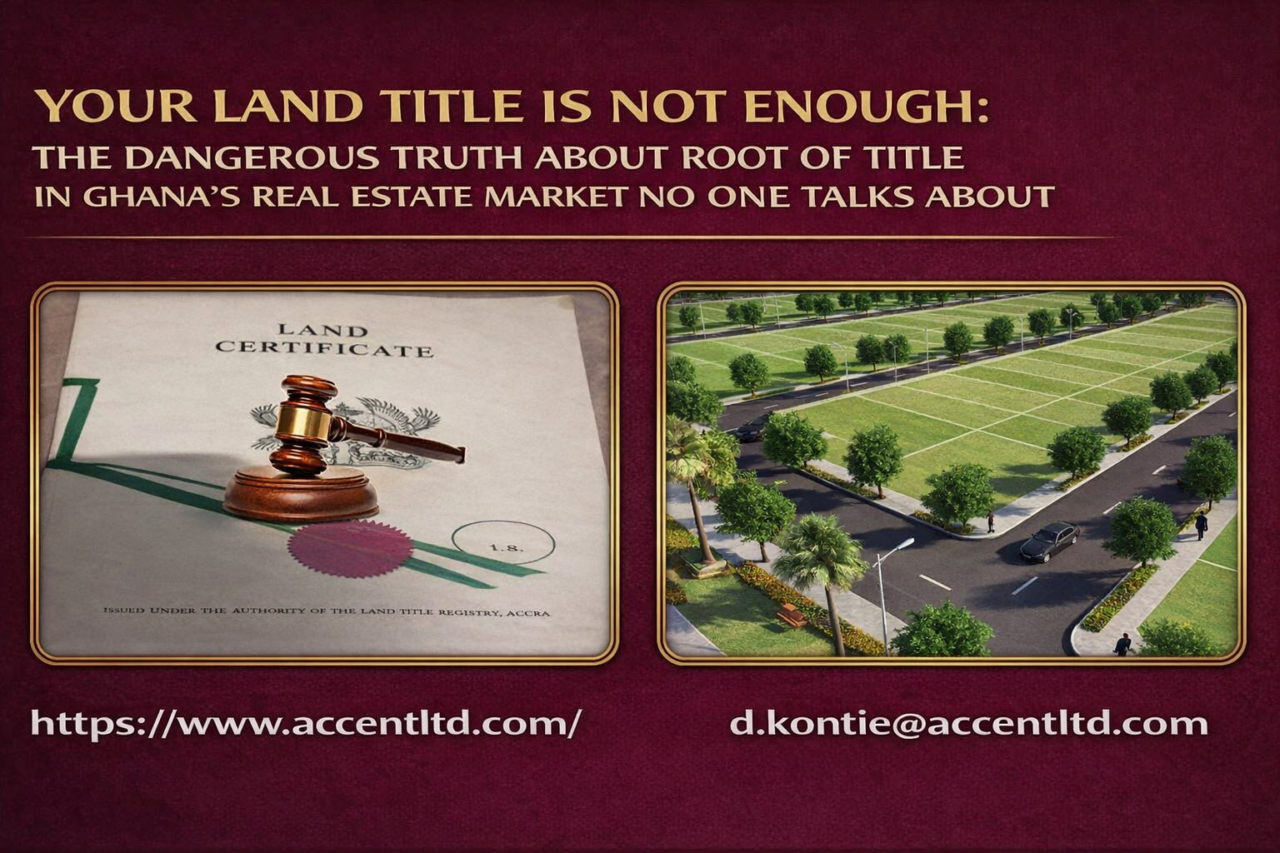
YOUR LAND TITLE IS NOT ENOUGH: THE DANGEROUS TRUTH ABOUT ROOT OF TITLE IN GHANA’S REAL ESTATE MARKET NO ONE TALKS ABOUT
In Ghana’s rapidly expanding real estate sector, one question dominates nearly every transaction; that is, “Does it have a Land Title Certificate?. While this question appears prudent, it is fundamentally incomplete and in many cases, dangerously misleading. A Land Title Certificate is widely perceived as conclusive proof of ownership.
In practice, however, it represents only a procedural record of an interest in land, not an absolute guarantee of lawful ownership. The distinction is critical, yet often overlooked by investors, developers and even some industry professionals.
At the core of land law lies the enduring legal doctrine “nemo dat quod non habet”, that is, one cannot give what one does not have. This principle is not merely academic, it is the legal foundation upon which valid title to land is built. It follows therefore that, the legitimacy of any land transaction depends not on the existence of documentation alone, but on the validity of the root from which that title is derived.
It is against this backdrop that I decided to educate the unsuspecting public, particularly diaspora investors who fall victim to erroneous perception most often. I examine the persistent misconception that a Land Title Certificate constitutes conclusive proof of ownership within Ghana’s real estate market. I interrogates the legal and practical limitations of title registration, particularly the extent to which defective root of title continues to undermine the validity of registered interests.
I further analyze Ghanaian law on proof of title, highlighting the centrality of root of title in resolving competing claims to land. Finally, I consider the implications for investors, developers and market actors and underscores the need for a more rigorous, root-focused approach to due diligence in land transactions rather than just title certificates.
But before we go into the details of today’s discussion, let me remind you that, the Africa Continental Engineering & Construction Network Ltd stands out as one of Ghana’s leading real estate developers and consultants. From land acquisition, title registration, architectural design, general construction, property development, real estate investment advisory services et cetera, we provide a 360ºC service experience.
If you are ready to move from interest to investment, simply search “Africa Continental Engineering & Construction Network Ltd” on Google. Visit our website, explore available properties and reach out to our team for a swift professional service delivery.
With thousands of serviced litigation-free parcels of land across Accra and key growth corridors, we are uniquely positioned to help you unlock value in residential, commercial and industrial real estate. Now, let us go into the nitty-gritty of the discussion starting with the centrality of root of title.
Centrality of Root of Title
The concept of root of title refers to the origin or foundation of a person’s claim to land. It answers the fundamental question: How did the purported owner acquire title in the first place? In Ghanaian jurisprudence, establishing a valid root of title is indispensable. The courts have consistently held that where title to land is in dispute, the success of a claim depends on proof of a credible and lawful root of title.
This position was emphatically affirmed in Amuzu v. Oklikah (Amuzu; 1998–1999), where the Supreme Court held that a party claiming ownership must succeed on the strength of their own title, which must be rooted in a valid and provable origin. A defective or unproven root is fatal to the claim, regardless of possession or documentation.
Similarly, in Quaye v. Kuevi (Quaye; Year), the court reiterated that in competing claims to land, priority is accorded not to the party with the most documentation or development, but to the party who can establish a better root of title. This underscores a crucial legal reality; that is, documentation does not cure illegitimacy.
Priority, Competing Claims and Judicial Determination
In resolving competing claims to land, the courts do not merely count documents; they evaluate the quality of title. The principle of priority is therefore not determined by the volume of documentation or the extent of development, but by the strength and legitimacy of the competing roots of title.
A party with fewer documents may prevail if their root is more credible and legally sound. This judicial approach reflects a consistent pattern within Ghanaian land law, where the courts prioritize substance over form and legitimacy over appearance.
Customary Land and the Complexity of Root Title
The complexity of root of title in Ghana is further compounded by the predominance of customary land ownership. In many instances, the true root of title originates from customary authorities, including stools, skins and families. Disputes frequently arise where grants are made without proper authority, without the requisite consent of principal elders, or in breach of customary law requirements.
In such cases, subsequent registration does not sanitize the defect. The validity of the title remains contingent on the legitimacy of the original customary grant, making it imperative to investigate not only documentary records but also the customary basis of ownership.
Limits of Land Title Registration
Ghana operates a dual system of land registration, deeds registration and title registration governed primarily by the Land Act, 2020 (Act 1036). While this framework aims to enhance certainty and security of tenure, they do not eliminate the risks associated with defective roots of title. The Lands Commission, as the statutory body responsible for registration, performs an administrative function.
Its role is to record interests in land, not to guarantee their substantive validity. Consequently, registration does not cure defects in title, nor does it extinguish competing claims arising from a superior root.
This position reflects the broader legal understanding that title registration in Ghana is not entirely indefeasible. Unlike some Torrens systems, where registration confers absolute ownership, Ghana’s system allows for registered titles to be challenged and set aside where fraud, mistake, or illegitimacy in the root of title is established.
Indefeasibility and the Limits of Registration
A more precise understanding of Ghana’s title registration regime further exposes the limitations of relying solely on title certificates. Unlike classical Torrens systems, which operate on the principle of absolute indefeasibility, Ghana’s regime under the Land Act, Act 2020 (Act 1036) 1986 embodies a qualified form of indefeasibility.
Registration confers strong evidentiary value and priority, but it does not render title immune from challenge. Where fraud, mistake, or illegitimacy in the root of title is established, the courts retain the authority to set aside registered interests. This doctrinal position reinforces a critical point; registration enhances title, but it does not create it. Therefore, the validity of title remains anchored in its origin, not merely its registration.
Fraud, Double Registration and Administrative Vulnerabilities
The persistence of defective titles within the registration system is closely linked to fraud, double registration and administrative lapses. In practice, it is not uncommon for multiple interests to be registered over the same parcel of land, often arising from competing grants, forged instruments, or incomplete verification processes.
These occurrences are not merely procedural anomalies, they represent substantive failures that allow illegitimate interests to acquire the appearance of legality. Consequently, the existence of a title certificate may reflect administrative acceptance rather than legal validity, further underscoring the need to interrogate the root of title beyond the register.
Derivative Title and the Transmission of Defects
A critical but often misunderstood principle in land transactions is that derivative title inherits all prior defects. In simple terms, if the grantor’s title is defective, every subsequent interest derived from it is equally defective. This has far-reaching implications. A purchaser may conduct a search, obtain a title certificate, and even develop the land yet, still lose everything if the root of title is later found to be invalid.
The law does not protect investments built on defective foundations. As the courts have repeatedly emphasized, development does not validate ownership. Nor does good faith acquisition automatically confer legal title where none existed (Woodman; 1996).
Systemic Challenges and Market Realities
The persistence of land disputes in Ghana is not accidental. It is driven by a combination of structural and institutional weaknesses, including fragmented customary and statutory land governance systems, inadequate coordination among land sector agencies, multiple sales of the same parcel of land and registration of interests without rigorous verification of root title.
These systemic gaps create an environment where individuals may appear legitimate on paper while lacking lawful ownership in substance. Compounding the problem is a significant knowledge gap within the market. Many intermediaries, agents, brokers and even some professionals either lack a proper understanding of root of title or fail to prioritize it in transactions.
As a result, unsuspecting buyers often acquire land without tracing its ownership history, purchase properties built on defective titles and rely solely on documentation without legal due diligence.
Reframing Due Diligence in Real Estate Transactions
To mitigate these risks, a fundamental shift in approach is required. Investors must move beyond superficial inquiries and adopt a more rigorous due diligence framework. The critical questions should include; what is the root of title, is the grantor’s ownership legally valid and traceable, are there competing claims from the source of title or has a comprehensive title investigation been conducted beyond registry searches? These questions go to the heart of ownership. They distinguish between mere documentation and true legal entitlement.
Operationalizing Due Diligence in Practice
A meaningful approach to due diligence must extend beyond registry searches and into a comprehensive investigation of title. This includes verification of records at the Lands Commission of Ghana, confirmation of customary ownership and consent where applicable, examination of prior transactions affecting the land and checks for pending or past litigation involving the property.
Physical site inspections and boundary verification are equally essential to ensure consistency between documentation and reality, without these steps, due diligence remains superficial and incapable of detecting defects embedded in the root of title.
Professional Responsibility and Market Gatekeepers
The responsibility for ensuring sound land transactions does not rest solely with purchasers. Legal practitioners, surveyors, valuers, and estate professionals serve as critical gatekeepers within the real estate ecosystem. Their role extends beyond facilitating transactions to safeguarding the integrity of title.
Where these professionals fail to rigorously interrogate root of title, they inadvertently contribute to the circulation of defective interests within the market. Strengthening professional standards and accountability is therefore essential to reducing land disputes and restoring confidence in the sector.
Economic Implications of Defective Title Systems
The implications of defective root of title extend beyond individual transactions to the broader economy. Persistent uncertainty in land ownership undermines investor confidence, increases transaction costs and contributes to capital inefficiencies within the real estate sector. Financial institutions become more cautious in extending credit secured by land, while developers face heightened risks that can stall or abandon projects. In this way, weaknesses in title legitimacy translate directly into reduced economic productivity and constrained sectoral growth.
The Absence of Title Insurance as a Risk Mitigation Tool
Notably, Ghana’s land market operates without a widely adopted system of title insurance, a mechanism commonly used in other jurisdictions to mitigate risks associated with defective title. The absence of such protection places the full burden of risk on purchasers and investors, further amplifying the consequences of inadequate due diligence and systemic weaknesses in land administration. This gap highlights the need for innovative risk management frameworks within Ghana’s real estate sector.
Conclusion
In conclusion, ownership of land in Ghana is not determined by the existence of a title certificate alone. It is determined by the legitimacy of the root from which that title flows. Until this reality is fully appreciated, land litigation will continue to plague the sector and investors will remain exposed to avoidable risks.
The ultimate question therefore, is not whether a property has a title but whether that title can withstand legal scrutiny at its root. Talk to Africa Continental Engineering and Construction Network for all your land or property acquisition needs and we will guide you through the process so you can secure your investment. Our over 10 years of work and experience positions us among Ghana’s leading developers and real estate consultants. With us, you are secured.
References
-
- Amuzu v. Oklikah (1998–1999) SCGLR 141. Available at: https://ghalii.org/gh/judgment/supreme-court/1998-1999/141
-
- Kasanga, K., & Kotey, N. A. (2001). Land Management in Ghana: Building on Tradition and Modernity. International Institute for Environment and Development. Available at: https://pubs.iied.org/9002IIED
-
- Kludze, A. K. P. (2004). Ewe Law of Property. Woeli Publishing Services. Available at: https://books.google.com
-
- Land Act, 2020 (Act 1036), Ghana. Available at: https://lawsghana.com/acts/id/212/land-act-2020-act-1036
-
- Land Title Registration Act, 1986 (PNDCL 152), Ghana. Available at: https://lawsghana.com/pre_1992_legislation/pndcl/land-title-registration-law-1986-pndcl-152
-
- Quaye v. Kuevi (Ghana High Court, Year). Available via Ghana Legal Information Institute (GhLII): https://ghalii.org
- Woodman, G. R. (1996). Customary Land Law in Ghana. Ghana Universities Press. Available at: https://books.google.com
Author
Daniel Kontie, CEO. Africa Continental Engineering & Construction Network Ltd.
Email: d.kontie@acecnltd.com
Tel: +233209032280
Daniel Kontie, CEO. Africa Continental Engineering & Construction Network Ltd.
Email: d.kontie@acecnltd.com
Tel: +233209032280
Post Views: 1,093


Contact Details
- Accra Tema comm 26
- info@acecnltd.com
- +233 20 903 2280
© 2026 reserved AFRICAN CONTINENTAL ENGINEERING CONSTRUCTION NETWORK
Leave Your Comment