- +233209032280
- Monday to Friday: 9am to 5pm

INVESTING IN DUBAI REAL ESTATE DURING GEOPOLITICAL UNCERTAINTY: RISKS, OPPORTUNITIES AND ALTERNATIVES - AFRICA CONTINENTAL ENGINEERING & CONSTRUCTION NETWORK
- Home
- INVESTING IN DUBAI REAL ESTATE DURING GEOPOLITICAL UNCERTAINTY: RISKS, OPPORTUNITIES AND ALTERNATIVES
03Apr’26
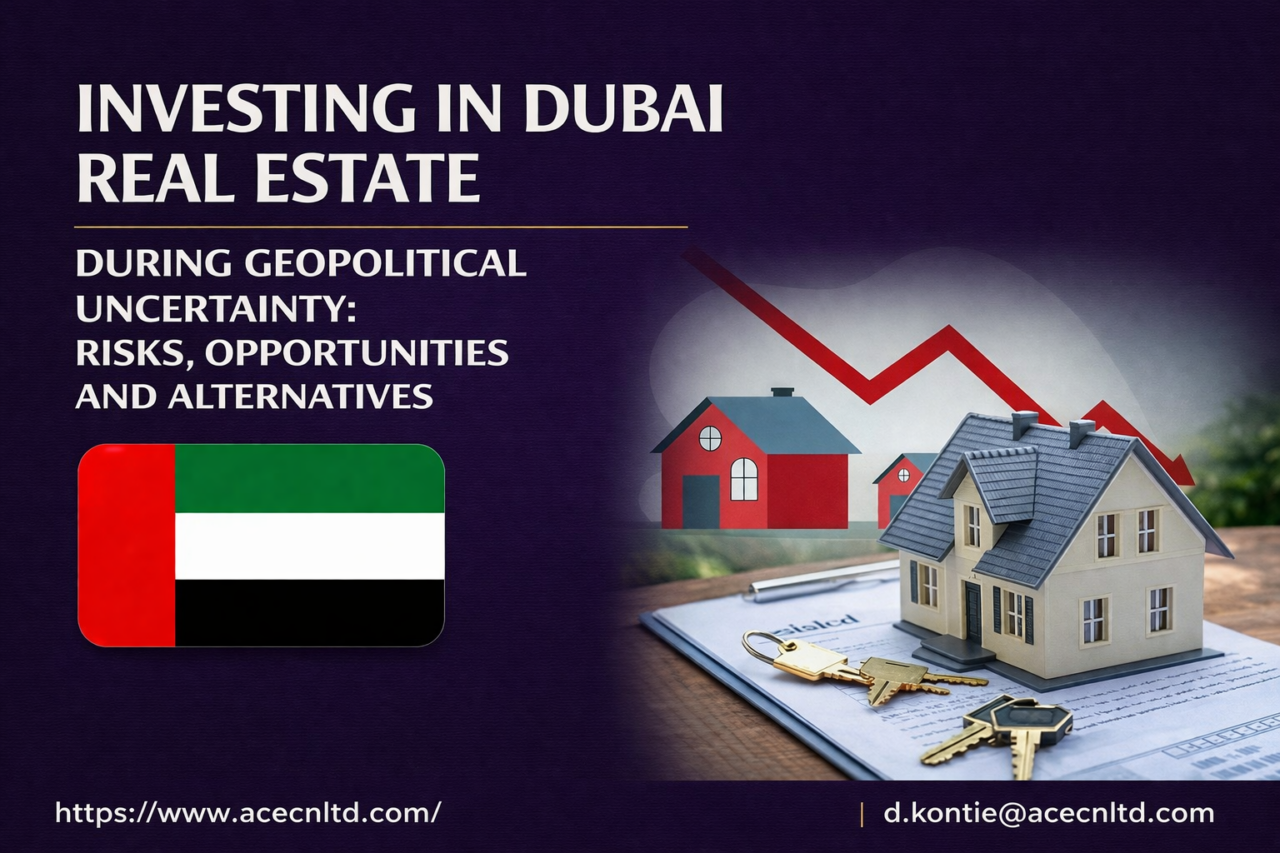
INVESTING IN DUBAI REAL ESTATE DURING GEOPOLITICAL UNCERTAINTY: RISKS, OPPORTUNITIES AND ALTERNATIVES
Global real estate markets are historically sensitive to geopolitical shocks, often reacting with short-term volatility but long-term resilience. The recent escalation of tensions involving Israel, the United States of America and Iran has triggered uncertainty across key investment destinations in the Middle East, including Dubai, one of the world’s most dynamic real estate hubs.
Amid reports of slowing demand, investor hesitation and price corrections, a critical question has emerged among international investors; should this period be viewed as a risk to avoid or a strategic entry point into the market at discounted valuations. In this article, we examine Dubai’s current situation in the context of global historical precedents and provide a data-backed guide for investors navigating this period of uncertainty.
But before we go into the nitty-gritty of today’s discussion, let me remind you that, the Africa Continental Engineering & Construction Network Ltd stands out as one of Ghana’s leading real estate developers and consultants. From land acquisition, title registration, architectural design, general construction, property development, real estate investment advisory services et cetera, we provide a 360ºC service experience.
If you are ready to move from interest to investment, kindly visit the property page, explore available properties and reach out to our team for a swift professional service delivery. With thousands of serviced litigation-free parcels of land across Accra and key growth corridors, we are uniquely positioned to help you unlock value in residential, commercial and industrial real estate. Now, let us go into the substantive discussion.
Dubai Real Estate under Pressure
Dubai’s real estate market has traditionally demonstrated strong resilience, underpinned by foreign investment inflows, tax advantages and its status as a global business and tourism hub. However, geopolitical instability in the Middle East introduces investor psychology risk, resulting in capital flight to perceived safe havens, deferred investment decisions and short-term price corrections.
According to recent market observations, transaction volumes took a nosedive and some speculative investors are exiting positions. However, it is critical to distinguish between market sentiment-driven corrections and fundamental economic decline. Dubai’s underlying fundamentals remain intact; zero property tax environment, strong tourism and expatriate inflows and continued infrastructure expansion etc. Historically, such fundamentals tend to anchor long-term market sustainability and that has always been the reason for Dubai’s real estate market resilience.
Lessons from History: How Real Estate Markets behave during Conflict
The Post-Gulf War Recovery in 1991: Following the Gulf War, regional real estate markets experienced a temporary decline. However, markets like Dubai rebounded strongly within a few years as stability returned and capital re-entered the region according to the World Bank (World Bank, 1992).
The 2008 Global Economic Melt-Down (2008–2012): Dubai’s property market saw prices fall significantly by over 50% during the crisis, however, investors who entered the market at that time realized significant gains during the recovery phase between 2010 and 2012 (Dubai Land Department, 2016).
Then Comes COVID-19 Pandemic in 2020: Global uncertainty led to a slowdown in real estate transactions worldwide. Dubai, however, recorded one of its strongest rebounds post-pandemic, with record-breaking transactions in 2021 to 2023 (Knight Frank, 2023).
Typically,real estate markets impacted by external shocks most often follow a correction, leading to stabilization, recovery and growth cycle.
Strategic Investment Perspective
For seasoned investors, uncertainty often presents counter-cyclical entry points. Key advantages of investing now include but not limited to:
Discounted Asset Prices: Periods of fear often lead to undervaluation of high-quality assets.
Reduced Competition: Fewer active buyers give negotiation power to prospective buyers.
Long-Term Capital Appreciation: As geopolitical tensions ease, markets typically rebound, restoring investor confidence and significant property appreciation.
Rental Yield Stability: Dubai continues to offer attractive rental yields averaging 5 to 8%, which helps cushion value volatility against capital (Global Property Guide, 2024).
Risks Investors must consider
It is also important to note that, investors must also weigh the downside which includes but not limited to the following, the possibility of a prolonged geopolitical instability, liquidity constraints in the short term, currency and capital flow risks and the overexposure to a single regional market. But the good news however is that, Dubai remains a high-potential by all permutations looking into the crystal ball.
Why Ghana is a Prime Alternative Investment Destination: Looking beyond Dubai
For investors seeking to hedge geopolitical risks, diversification into emerging high-growth real estate markets is not only prudent but a strategic option. As uncertainty in Dubai creates hesitation, Ghana presents a compelling, data-backed alternative to such investors. Below are a few a statistics to buttress this position.
Strong Housing Demand across all Segments: Ghana’s housing deficit exceeds 1.8 million units according to the Ministry of Works and Housing (Ministry of Works and Housing, 2023).Annual housing demand is estimated at over 120,000 units, with supply far below this threshold reported by the World Bank in 2020 (World Bank, 2020).
Moreover, the Ghana Statistical Service reported that, urban population growth continues to exceed 3% annually, directly fueling real estate demand in urban centers such as Accra (National Capital), Kumasi, Ashanti Regional Capital, Takoradi, Western Regional Capital, Tamale, Northern Regional Capital etc (GSS, 2022).
Luxury Segment: Growing expatriate and high-net-worth demand in Accra such as Airport Residential area, Cantonment, Osu, Roman Ridge, North Ridge, Burma Hills, East Legon, East Legon Hills, Dzorwulo etc, coupled with the risingdemand for serviced apartments and gated communities along all growth corridors.
Mid-Income Segment: Rapid urbanization driving demand for affordable housing, the expansion of mortgage and developer-financing schemes, mortgage affordability and accessibility occasioned by the recent strong macroeconomic fundamentals.
Mixed-Use Developments: Rising interest in integrated developments combining residential, retail and office spaces coupled with the growth of urban commercial hubs across major urban centers etc.
Ghana as Gateway Access to ECOWAS Regional Market: Unlike saturated global markets, Ghana remains a promising real estate market offering first-mover advantages, lower entry costs and significant capital appreciation potential, particularly in mixed-use and modern housing developments.
Additionally, Ghana’s stable political environment and its strategic position as a gateway to the ECOWAS region further reduces investment risk while providing access to a broader West African market. This makes Ghana a high-growth, high-return destination for real estate investment.
Conclusion: A Dual Strategy for Smart Investors
In conclusion, Dubai’s current situation should not be viewed purely as a risk, but rather as a strategic inflection point. For investors with a long-term outlook and strong risk appetite, this may be an ideal time to acquire undervalued assets in anticipation of market recovery. However, for investors seeking stability, diversification and high-growth emerging market exposure, Ghana stands out as a compelling alternative.
If you are reading this article as a real estate investor uncertain about entering the Dubai market at this time, Ghana offers a highly attractive and underexplored opportunity across luxury, mid-income and mixed-use real estate segments. Kindly contact Africa Continental Engineering & Construction Network Ltd, we are well-positioned to partner with investors interested in the Ghanaian market.
We have and will provide the requisite market intelligence, facilitate property acquisition/development, support regulatory navigations and deliver end-to-end investment execution.
But before we part, do note that information provided in this article or any article by this writer are the opinions or views of the writer for general informational purposes and does not constitute professional or legal advice. Readers are therefore advised to consult us as their certified professionals/consultants or any certified professional or consultant, before making any legally binding decision or making any commitment that has financial implications.
References
- Dubai Land Department (2016). Dubai Real Estate Market Report. https://dubailand.gov.ae
- Global Property Guide (2024). Dubai Rental Yields and Market Trends. https://www.globalpropertyguide.com
- Ghana Statistical Service (2022). Population and Housing Census Report. https://statsghana.gov.gh
- Knight Frank (2023). Dubai Residential Market Review. https://www.knightfrank.com
- Ministry of Works and Housing, Ghana (2023). National Housing Policy Report. https://mwh.gov.gh
- World Bank (1992). Post-Conflict Economic Recovery in the Gulf Region. https://www.worldbank.org
- World Bank (2020). Ghana Housing Sector Diagnostic. https://www.worldbank.org
About Author
Daniel Kontie is a young enthusiastic Ghanaian Entrepreneur, the Executive Chairman of the Africa Infrastructure Group; comprising the Africa Continental Engineering & Construction Network Ltd (ACECN), Falcon 48 Developers; Africa Infrastructure Energy and Africa Land Banking Investment Ltd. All these are infant establishments, disrupting the conventional way of brand building across the African Continent. Daniel is a columnist, a writer and a member of the Ghana Built Environment Writers Association. He can be contacted via Tel: +233209032280; Email: d.kontie@acecnltd.com; Website: https://acecnltd.com/
Post Views: 500


Contact Details
- Accra Tema comm 26
- info@acecnltd.com
- +233 20 903 2280
© 2026 reserved AFRICAN CONTINENTAL ENGINEERING CONSTRUCTION NETWORK
Leave Your Comment