- +233209032280
- Monday to Friday: 9am to 5pm

RED FLAGS IN GHANA’S PROPERTY MARKET [PART 11]: THE FAKE TITLE CERTIFICATE PROBLEM - WHEN BUYERS TRUST DOCUMENTS THEY CANNOT AUTHENTICATE - AFRICA CONTINENTAL ENGINEERING & CONSTRUCTION NETWORK
- Home
- RED FLAGS IN GHANA’S PROPERTY MARKET [PART 11]: THE FAKE TITLE CERTIFICATE PROBLEM – WHEN BUYERS TRUST DOCUMENTS THEY CANNOT AUTHENTICATE
28May’26
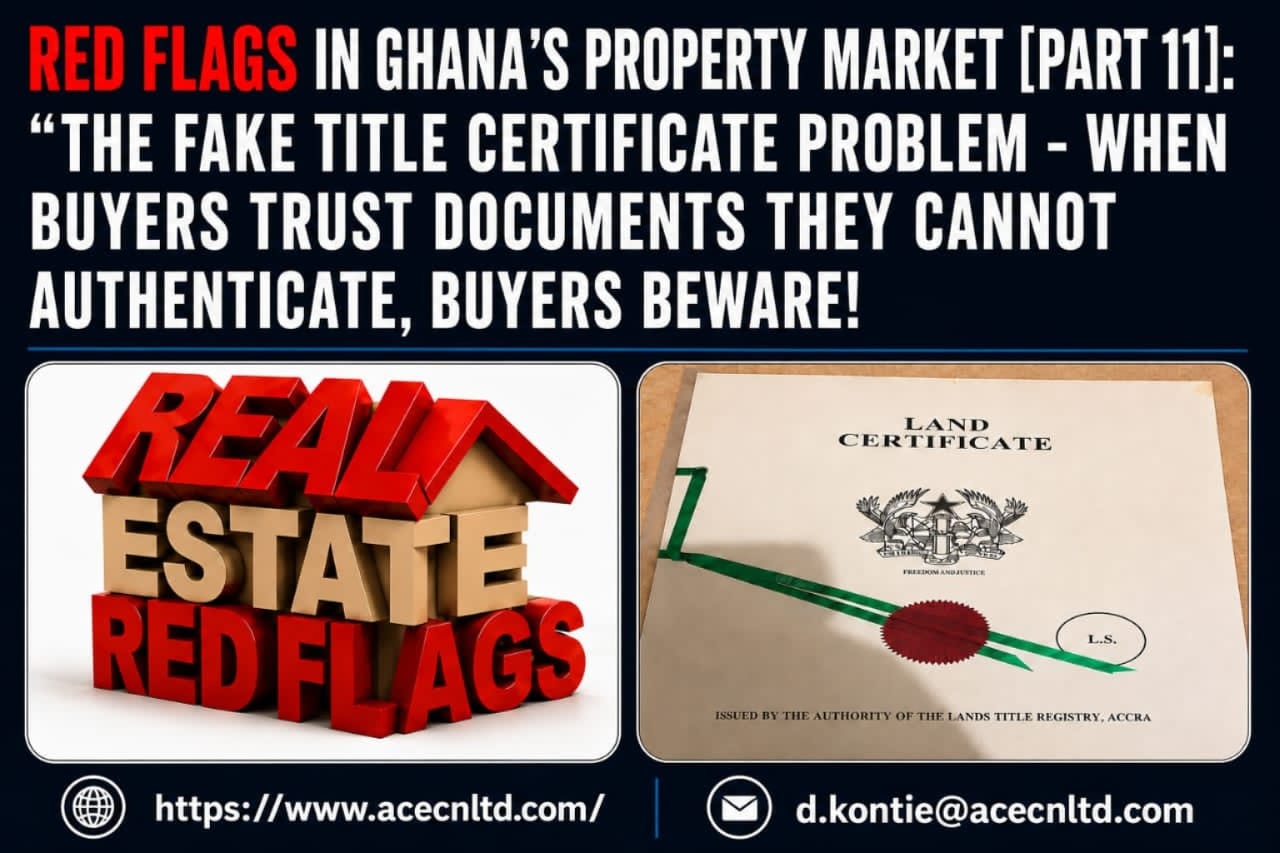
RED FLAGS IN GHANA’S PROPERTY MARKET [PART 11]: THE FAKE TITLE CERTIFICATE PROBLEM – WHEN BUYERS TRUST DOCUMENTS THEY CANNOT AUTHENTICATE
For many property buyers in Ghana today, the phrase “the land is titled” has gradually become a psychological substitute for safety. The moment a seller produces a land title certificate, stamped site plans, indentures and official-looking paperwork, many buyers immediately lower their guard.
Within parts of Ghana’s property market, the mere existence of documentation is often treated as conclusive proof of legitimacy. Unfortunately, reality is proving otherwise. One of the most dangerous transformations currently taking place in Ghana’s property sector is the evolution of land fraud from crude multiple sales into highly sophisticated document-based deception.
The modern problem is no longer simply about people selling land without papers. Increasingly, the challenge is that buyers are being presented with documents that appear genuine, professionally processed, institutionally backed and legally convincing, yet some of these documents are manipulated, fraudulently obtained, forged or legally defective.
What makes the fake title certificate problem particularly dangerous is that the deception no longer looks informal. It looks official. In Ghana today, some buyers trust paper more than process. That mistake is becoming increasingly costly.
In this article, I examine the growing problem of fake and fraudulently procured title certificates within Ghana’s property market and why the mere existence of official-looking land documents no longer guarantees ownership legitimacy.
I explore how modern land fraud has evolved from crude multiple sales into sophisticated document-based deception involving manipulated registrations, defective root titles, irregular institutional processes and professionally packaged paperwork that many buyers struggle to authenticate independently.
The article further analyzes the legal realities surrounding title registration in Ghana, the psychological power of “official documents,” the risks of institutional weaknesses and why due diligence must extend far beyond simply inspecting papers.
Ultimately, this discussion highlights the urgent need for deeper verification, stronger institutional transparency and more informed property investment practices in Ghana’s rapidly expanding real estate sector.
But before we go into the nitty-gritty of today’s discussion, let me remind you that, the Africa Continental Engineering & Construction Network Ltd stands out as one of Ghana’s leading real estate developers and consultants.
From land acquisition, title registration, architectural design, general construction, property development, real estate investment advisory services et cetera, we provide a 360ºC service experience.
If you are ready to move from interest to investment, kindly search on Google, “Africa Continental Engineering & Construction Network Ltd”, visit our investment and property pages, explore available properties and reach out to our team for a swift professional service delivery.
With thousands of serviced litigation-free parcels of land across Accra and key growth corridors, we are uniquely positioned to help you unlock value in residential, commercial and industrial real estate. Now, let us go into the substantive discussion starting with the growing complexity of land fraud in Ghana.
The Growing Complexity of Land Title Fraud in Ghana
Years ago, land fraud was easier to identify. Many fraudulent transactions involved handwritten allocation notes, unsigned indentures, conflicting family claims or obvious multiple sales. Today, however, the fraud architecture has become significantly more sophisticated.
Buyers are now encountering title certificates with registry references, official stamps, cadastral plans, survey coordinates, embossed seals, barcodes, signatures and supporting documents that appear completely authentic on the surface.
Some fraudulent actors have become so sophisticated that they combine genuine historical records with manipulated information, making detection extremely difficult for ordinary buyers. In some situations, the document itself may not immediately appear fake.
The deeper problem may lie in the legitimacy of the root title, the authority of the grantor, manipulated registry entries, irregular concurrence procedures or questionable transfers hidden beneath layers of paperwork. This explains why many disputes today involve parties who all appear to possess “valid documents.”
Ghanaian courts have repeatedly emphasized that registration alone does not automatically cure fraud or validate defective ownership. In Papa Gyimah Genfi v. Dr. J.K. Acquaye, the Court reaffirmed the long-established legal principle that fraud vitiates everything, including land transactions.
Similarly, in Wrangler Ghana Ltd v. Spectrum Industries Pvt Ltd, the Court stressed that registration obtained through fraud or defective processes can still be challenged and nullified.
These judicial decisions expose one uncomfortable reality within Ghana’s property market, a title certificate may create confidence, but confidence is not always the same as legitimacy.
Why Buyers Struggle to Authenticate Land Titles
One of the biggest vulnerabilities in Ghana’s property market is that many buyers simply do not possess the technical capacity to independently authenticate land documents.
To the ordinary purchaser, once documents appear official and the seller sounds convincing, the transaction is often assumed to be safe, meanwhile, genuine verification goes far beyond physically seeing papers.
Authenticating land ownership in Ghana may require careful examination of root title history, cadastral consistency, survey authenticity, grantor authority, litigation records, encumbrances, customary ownership legitimacy, registration chronology, boundary verification and institutional records.
Most buyers are unfamiliar with these processes. As a result, they depend heavily on agents, brokers, middlemen, family representatives, surveyors, lawyers or sellers whose interests may not necessarily align with full transparency. This information imbalance creates fertile ground for manipulation.
Research by Ehwi and Asante (2016) observed that despite reforms under Ghana’s Land Administration Project, significant operational weaknesses, delays, inconsistencies and administrative challenges continued to affect confidence in the land registration system.
These vulnerabilities create opportunities for fraudulent actors to exploit institutional gaps. The danger is therefore no longer merely untitled land, the danger is professionally packaged illegitimacy.
The Insider Collusion Fear
Perhaps the most disturbing aspect of the fake title certificate problem is the persistent public suspicion of insider collusion within sections of the land administration system.
Over the years, allegations have repeatedly emerged involving duplicate title registrations, disappearance of land files, unauthorized alterations to records, suspicious backdating of registrations, illegal insertion of names into official records, conflicting searches on the same parcel of land and overlapping title issuances.
Whether proven or alleged, the consistency of these accusations has significantly weakened public confidence in the integrity of parts of the land administration process.
In 2014, reports linked to investigations by the Ghana Police CID Property Fraud Unit raised concerns about alleged irregularities involving some officials within the Lands Commission. Similar concerns have surfaced in multiple land disputes over the years.
In Nii Kofi Akrashie II v. Jobbies Limited and Others, the High Court reportedly found that a title certificate had been fraudulently procured through irregular processes involving registration procedures and signatures.
The Court subsequently ordered the deletion of the title from official records. In another matter reported in 2024, the High Court ordered the deletion of certain land entries and title records following findings connected to alleged fraudulent boundary extensions and improper registrations.
These developments reinforce a troubling perception within the market, sometimes, fraudulent documentation may initially survive within official systems long enough to deceive innocent buyers. That reality has serious implications for investor confidence.
The Psychological Power of “Official Documents”
One reason sophisticated land fraud continues to succeed is because many buyers are psychologically conditioned to associate official-looking documents with unquestionable legitimacy. Fraudsters understand this very well.
Once buyers see stamps, seals, signatures, registry references, site plans and legal terminology, skepticism often reduces dramatically. Some victims become more convinced by the appearance of paperwork than by the actual legitimacy of ownership itself.
This psychological manipulation is often reinforced through urgency and social pressure. Buyers are frequently told that the documents are complete, the land is fully titled, another buyer is already interested or everything has already been processed at the Lands Commission.
Under pressure to secure appreciating land quickly, many buyers rush into transactions without conducting deeper investigations. Research into fraud persuasion techniques has consistently shown that scammers frequently exploit authority signals, urgency, credibility displays and emotional pressure to reduce critical scrutiny (Van Der Zee, Clayton, & Anderson, 2019).
In Ghana’s property market, the same pattern increasingly appears within sophisticated land transactions. A forged document with institutional appearance can sometimes move faster than genuine ownership.
Registration Does Not Automatically Mean Ownership
One of the most misunderstood issues in Ghana’s property market is the assumption that registration automatically means ownership is legally secure. That assumption is dangerously simplistic.
Under Ghanaian law, courts are often concerned not only with whether a document was registered, but whether the underlying transaction itself was lawful, legitimate, properly granted and free from fraud.
This means courts may still examine the root of title, competing ownership interests, legitimacy of customary grants, procedural irregularities, fraud allegations and the lawful authority of grantors. Where fraud or illegality is established, registrations may be cancelled.
This principle has repeatedly appeared in Ghanaian land litigation, including disputes involving fraudulent registrations and contested title certificates such as Salomey Shorme Tetteh & Nii Amon Tafo v. Mary Korkor Hayford.
The practical implication is profound. Buyers who rely exclusively on the existence of a title certificate without investigating the legitimacy behind it may unknowingly inherit years of litigation, financial exposure and uncertainty.
The Financial and Emotional Consequences for Buyers
The consequences of fake title fraud extend far beyond financial loss alone. For many victims, the experience becomes emotionally exhausting, psychologically draining and socially damaging.
Some buyers discover competing claims only after fencing the property, commencing construction, securing financing, relocating family members or publicly announcing ownership.
Some victims spend years in litigation. Others abandon projects midway due to legal uncertainty. In more severe situations, disputes escalate into threats, intimidation, land guard confrontations, or community tensions.
Many buyers discover too late that ownership disputes can outlive savings, patience and even personal relationships. This is why land fraud remains one of the most destructive forms of investment risk within Ghana’s built environment.
Why Due Diligence Must Go Beyond Documentation
One of the most dangerous mistakes property buyers make is believing that due diligence simply means collecting photocopies of documents. Real due diligence is far more extensive.
In Ghana’s current property environment, proper verification may require independent legal review, Lands Commission verification, litigation searches, physical boundary confirmation, survey authentication, local community intelligence, customary ownership verification, grantor legitimacy checks and institutional consistency assessments.
Buyers must understand that genuine-looking documentation alone is no longer sufficient protection. The modern property fraudster understands documentation very well. In some cases, they understand it better than the buyer.
What many purchasers fail to appreciate is that fraud today may hide behind professional presentation, technical language and institutional appearance.
Institutional Reform and the Need for Digital Transparency
Ghana’s land sector has undergone several reforms aimed at improving efficiency, title security, digitization and transparency. The Land Administration Project represented a major attempt to modernize land governance and reduce systemic weaknesses.
However, persistent disputes, allegations of irregular registration practices and growing public distrust suggest that significant challenges remain.
As land values continue rising across urban and peri-urban Ghana, stronger institutional safeguards may become increasingly necessary.
Greater digitization of records, integrated verification systems, improved cadastral coordination, stronger anti-corruption enforcement, enhanced public access to verification tools and more transparent registration processes may become essential if confidence in land administration is to improve.
Without stronger institutional credibility, the market risks creating a dangerous environment where documentation itself gradually loses public trust. That would have serious consequences not only for buyers, but also for investment confidence, urban development and national economic growth.
A Guide to Starting the Process
One of the biggest challenges for buyers is how to bring all these checks together without wasting time or increasing costs. A more effective approach is to engage a qualified real estate consultant or legal professional who can coordinate the entire due diligence process.
Instead of dealing separately with surveyors, lawyers and planners, the buyer works with a central expert who manages everything. This approach reduces risk, prevents costly mistakes and ensures that all necessary checks are properly carried out in the right order.
This is where the expertise of the Africa Continental Engineering & Construction Network Ltd becomes valuable. At our firm, due diligence goes far beyond the standard checks.
In addition to title verification, we conduct title root tracing, litigation history searches, encumbrance checks and collateral registry reviews. We also gather on-the-ground information through community engagement, recognizing that important insights are often not captured in official records.
As a final step, we may test possession through controlled site activity to uncover any hidden disputes. This comprehensive approach has helped identify issues that routine checks often miss.
However, do not try this controlled site possession check because it involves risks and should always be handled by our team of experienced professionals.
Conclusion
The fake title certificate problem reveals a painful but important reality within Ghana’s property market. Not every official-looking document represents genuine ownership. Today, fraud in the land sector is evolving faster than many buyers’ understanding of due diligence.
The problem is no longer merely about missing documents. Increasingly, it is about sophisticated manipulation hidden behind institutional appearance. In this environment, buyers who mistake paperwork for legitimacy expose themselves to enormous risk.
The lesson is therefore clear, ownership security in Ghana cannot be determined solely by how impressive documents appear. True security lies in the legality, traceability, authenticity and integrity underlying those documents.
As Ghana’s property market continues expanding, the ability to distinguish genuine ownership from professionally packaged deception may increasingly determine who preserves wealth and who loses it.
References
- Ehwi, R. J., & Asante, L. A. (2016). Ex-post analysis of land title registration in Ghana since 2008 merger: Accra Lands Commission in perspective. SAGE Open, 6(2). https://doi.org/10.1177/2158244016643351
- Papa Gyimah Genfi v. Dr. J. K. Acquaye, Suit No. H1/189/2013, Court of Appeal, Ghana.
- Salomey Shorme Tetteh & Nii Amon Tafo v. Mary Korkor Hayford, Civil Appeal No. J4/34/2011, Supreme Court of Ghana.
- Van Der Zee, S., Clayton, R., & Anderson, R. (2019). The gift of the gab: Are rental scammers skilled at the art of persuasion? arXiv.
- Wrangler Ghana Ltd v. Spectrum Industries Pvt Ltd, Suit No. H1/109/2021, Court of Appeal, Ghana.
- “High Court Orders Lands Commission to Delete All Odai Ntow Family Entries & Titles in Public Records.” News Ghana, July 25, 2024.
- “Nii Kofi Akrashie II v. Jobbies Limited and Others (E1/SHC/11/2024) [2025] GHAHC 211.”
- “Police CID Exposes Rot @ Lands Commission, Corrupt Officials in Double Land Registration.” Modern Ghana, August 28, 2014.
About Author
Daniel Kontie is a young enthusiastic Ghanaian Entrepreneur, the Executive Chairman of the Africa Infrastructure Group; comprising the Africa Continental Engineering & Construction Network Ltd (ACECN), Falcon 48 Developers; Africa Infrastructure Energy and Africa Land Banking Investment Ltd. All these are growing establishments, disrupting the conventional way of brand building across the African Continent. Daniel is a columnist, a writer and a member of the Ghana Built Environment Writers Association. He can be contacted via Tel: +233209032280; Email: d.kontie@acecnltd.com; Website: https://acecnltd.com/.
Post Views: 1,843


Contact Details
- Accra Tema comm 26
- info@acecnltd.com
- +233 20 903 2280
© 2026 reserved AFRICAN CONTINENTAL ENGINEERING CONSTRUCTION NETWORK
Leave Your Comment