- +233209032280
- Monday to Friday: 9am to 5pm

RED FLAGS IN GHANA’S PROPERTY MARKET [PART 4]: THE LANDS COMMISSION MYTH - WHY “OFFICIAL SEARCH RESULTS” CAN STILL MISLEAD YOU - AFRICA CONTINENTAL ENGINEERING & CONSTRUCTION NETWORK
- Home
- RED FLAGS IN GHANA’S PROPERTY MARKET [PART 4]: THE LANDS COMMISSION MYTH – WHY “OFFICIAL SEARCH RESULTS” CAN STILL MISLEAD YOU
02May’26
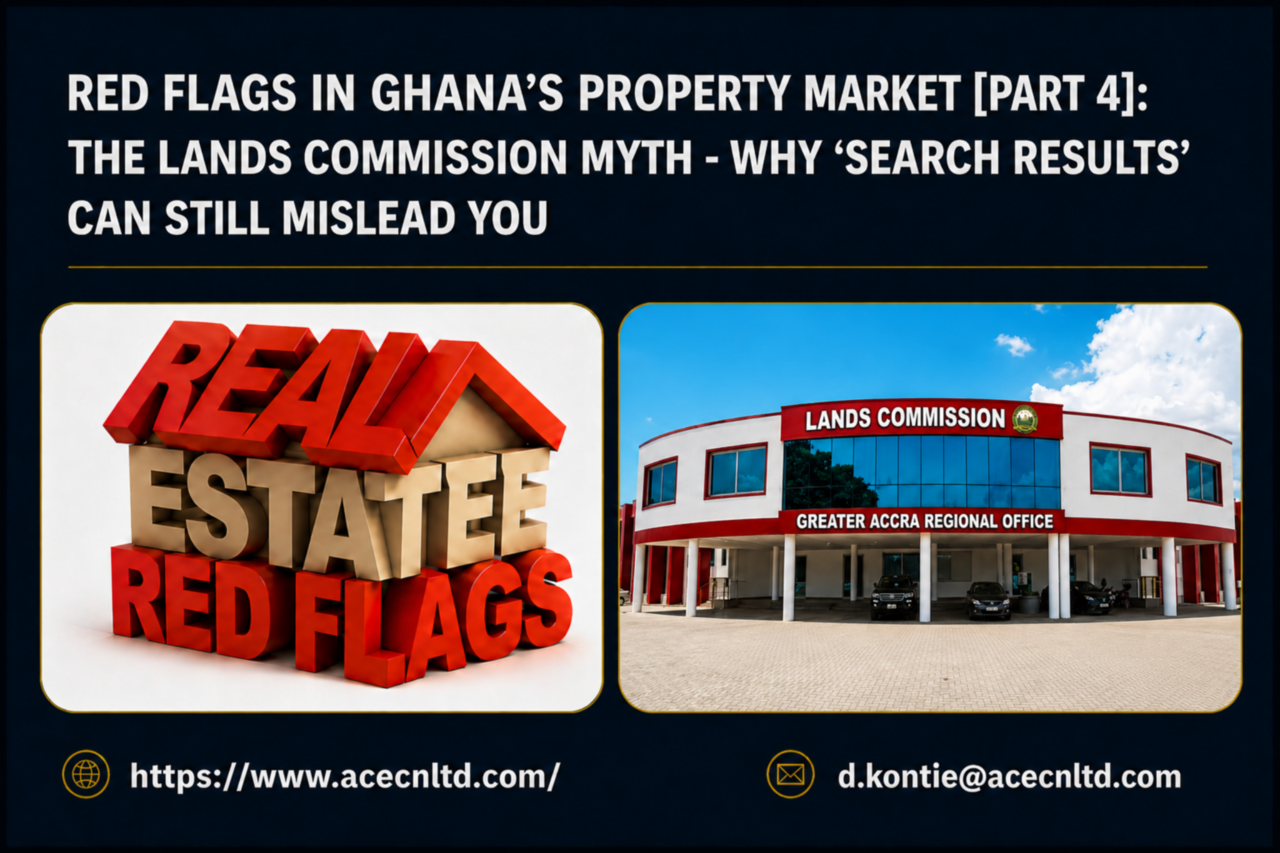
RED FLAGS IN GHANA’S PROPERTY MARKET [PART 4]: THE LANDS COMMISSION MYTH – WHY “OFFICIAL SEARCH RESULTS” CAN STILL MISLEAD YOU
In Ghana’s property market, the practice of conducting a search at the Lands Commission is widely regarded as the ultimate safeguard in ascertaining title security. For many buyers, investors and even professionals within the built environment, the search report is treated as conclusive proof of ownership and legitimacy.
However, this confidence is increasingly misplaced. There are growing instances where official search results do not resolve ownership questions but instead deepen uncertainty. The purpose of today’s article is to interrogate the gap between public confidence in official land searches and the realities of land ownership verification in Ghana.
Drawing on a real-world case involving conflicting title records, it unpacks the limitations of search reports issued by the Lands Commission, explores the impact of data gaps and registration delays and shows how competing claims and even fraud, can survive “official verification.” The central argument is straightforward: reliance on search results alone is inadequate and only a more rigorous, multi-layered approach to due diligence can meaningfully reduce risk.
But before we go into the nitty-gritty of today’s discussion, let me remind you that, the Africa Continental Engineering & Construction Network Ltd stands out as one of Ghana’s leading real estate developers and consultants. From land acquisition, title registration, architectural design, general construction, property development, real estate investment advisory services et cetera, we provide a 360ºC service experience.
If you are ready to move from interest to investment, kindly search on Google, “Africa Continental Engineering & Construction Network Ltd”, visit our property page, explore available properties and reach out to our team for a swift professional service delivery.
With thousands of serviced litigation-free parcels of land across Accra and key growth corridors, we are uniquely positioned to help you unlock value in residential, commercial and industrial real estate. Now, let us go into the discussion starting with a real recent experience trying to serve one of our clients.
A Real Case: When the Records Tell Conflicting Stories
A recent professional experience illustrates this concern in a very practical way. A title root search we conducted on behalf of a client produced a report so internally inconsistent that it failed to answer the most fundamental question; who truly owns the land.
The search findings revealed a fragmented and contradictory ownership history. The land in question was identified as Nungua Stool land that had been compulsorily acquired by the Republic of Ghana in 1940. Decades later, in 2010, it was released back to the Stool, which subsequently transferred ownership to a private developer, Woodfield Development. This interest was later transferred to Cosmos Real Estate, suggesting a seemingly straightforward chain of title.
However, the same report introduced a conflicting narrative by indicating that the land had also been affected by plotting activities attributed to another company (name withheld), with a separate title number issued in that entity’s name by grantor’s name that never appeared from the beginning. This created a clear disconnect in the chain of title, effectively producing parallel claims originating from the same root without any coherent legal reconciliation.
Seeking further clarity, we shared the report which was independently reviewed by multiple professionals, including an experienced land surveyor, a seasoned property lawyer and even a lawyer working within the Lands Commission itself. In all instances, none could conclusively state which party held legitimate ownership.
As a result, we have not been able to ask the client to go ahead and make payment, 4 weeks now after the search. This inability to reach a conclusion, despite reliance on official records, highlights a systemic issue rather than an isolated anomaly. This is just the most recent experience shared in this article, time and space will fail us if want to give account of all the cases we encountered as a leading real estate consultant and developer.
The Limitations of Official Searches
At the core of this problem is a widespread misunderstanding of what a Lands Commission search actually represents. A search report is fundamentally an administrative record, it reflects entries within a registry but does not constitute a legal determination of ownership. In other words, it shows what has been recorded, not necessarily what is legally valid.
The coexistence of customary and statutory land governance systems, commonly referred to as legal pluralism produces an environment where land disputes tend to follow fairly predictable litigation patterns, largely due to persistent overlaps, inconsistencies and unresolved tensions. Within such a system, multiple interests in land can exist simultaneously and not all of them are captured or reconciled within formal registration systems.
As a result, a search report may omit unregistered interests, unresolved disputes, or competing customary claims. Ubink and Quan (2008) further observe that land registration systems in similar contexts often function as repositories of claims rather than as mechanisms for conclusively adjudicating those claims. This structural limitation explains why conflicting interests can appear within the same search report without any definitive indication of priority or validity.
Data Gaps and Registration Delays
Beyond conceptual limitations, practical challenges within the land administration system further undermine the reliability of search results. Ghana’s land records have historically been affected by fragmentation, incomplete documentation and delays in registration processes. Although efforts at digitization have been initiated, the system is still in transition, leaving significant gaps in data integrity.
The World Bank (2019), notes that inefficiencies in land registration, including bureaucratic delays and inconsistent record-keeping, continue to affect the accuracy and completeness of official land data. In practice, this means that a legally valid transaction may not yet be reflected in the system, while a recorded transaction may later be subject to dispute or invalidation.
In the case under discussion, the appearance of a separate title in the final supposed legitimate title holder according to the search report, alongside an existing chain of transfers suggests either a parallel registration that was not properly reconciled or the existence of an unresolved dispute that was never fully addressed before subsequent entries were made. In either scenario, the integrity of the record is compromised.
Why Fraud Can Still Pass “Official Verification”
Perhaps the most concerning implication of these systemic weaknesses is that, fraudulent or defective transactions can pass through official processes and appear legitimate on the surface. This occurs for several reasons. First, the verification processes at the point of registration are not always sufficiently rigorous.
Officials often rely on documents submitted by applicants without independently verifying their authenticity or the legitimacy of the underlying transaction. Second, customary land authorities, including stools and families may allocate the same parcel of land to multiple parties, either inadvertently or deliberately, creating overlapping claims from the outset.
Additionally, poor coordination between key institutions involved in land administration such as the Lands Commission, the Survey Department and planning authorities, creates opportunities for inconsistencies and duplication. These institutional gaps are often exploited by actors who understand how to navigate the system’s weaknesses, using delays and ambiguities to their advantage.
The Illusion of Certainty in Title Registration
Ghana’s adoption of a title registration system was intended to provide certainty of ownership. In theory, such systems confer indefeasible title, meaning that registered ownership cannot easily be challenged. In practice, however, Ghana’s system does not fully achieve this standard.
Dowuona-Hammond (2003) explains that while title registration represents a significant improvement over deed registration, it does not eliminate the risk of competing claims, particularly where registration is based on flawed documentation or where disputes have not been conclusively adjudicated prior to registration.
Consequently, the presence of a title certificate should not be interpreted as absolute proof of ownership. The experience described earlier, where even professionals within the system could not confirm ownership, underscores the gap between theoretical expectations and practical realities.
Rethinking Due Diligence in Ghana’s Property Market
The implications of these findings are clear; reliance on Lands Commission searches alone is insufficient. Effective due diligence in Ghana requires a more comprehensive and multi-layered approach that goes beyond formal records. It involves a critical examination of the title history, verification of survey data, investigation of potential disputes and engagement with local communities to uncover informal or undocumented claims.
Equally important is the need for professional skepticism. Where inconsistencies arise, particularly those that cannot be resolved through expert review, they should be treated as serious warning signs. In some cases, the most prudent decision may be to refrain from proceeding with the transaction altogether.
Now, a Guide to Starting the Process
Having said this, the multi-million dollar question is, how will the individual be able to put together all these pieces of relevant information or the professionals needed to conduct a comprehensive due diligence whilst saving time and cutting cost. A prudent property acquisition process must begin with the engagement of a reputable real estate consultant or a real estate legal practitioner who serves as the central coordinator of all pre-purchase and transaction requirements.
This takes away from the buyer, the burden of having to source individually, surveyors, legal practitioners, planners and other professionals relevant to the process. The consultant synchronizes these services, ensuring that the due diligence is properly sequenced, verified and professionally conducted.
This coordinated approach significantly reduces risk; curtail cost overruns and procedural errors, while providing the buyer with clarity and confidence throughout the process. This is where the expertise of the Africa Continental Engineering & Construction Network Ltd comes into play.
At Africa Continental Engineering & Construction Network Ltd, our due diligence extends far beyond conventional Lands Commission searches. In addition to standard title verification, we undertake comprehensive title root tracing, litigation history checks, encumbrance searches and collateral registry reviews.
We also incorporate on-the-ground intelligence through discreet community engagement, recognizing that critical insights often reside outside formal records. As a final validation step, we test possession by initiating controlled site activity, such as clearing or minor works, to surface any latent disputes.
This layered and unconventional approach has enabled us to uncover hidden litigations and competing claims that routine searches may miss. However, such processes carry inherent risks and should not be attempted without professional guidance, engage our team to navigate them safely and effectively on your behalf.
Conclusion: Beyond the Myth of Official Assurance
In conclusion, the notion that a Lands Commission search guarantees the safety of a land transaction is, at best, an oversimplification and at worst, a dangerous misconception. As demonstrated, the system can accommodate multiple, conflicting claims without providing a clear mechanism for determining which one prevails.
Until Ghana’s land administration system achieves full integration, improved verification standards and greater institutional coordination, the burden of ensuring transaction security will continue to rest heavily on buyers and their advisors. In this context, the greatest risk is not merely the absence of information, but the false confidence that arises from assuming that official records are complete, accurate and conclusive.
References
- Bugri, J. T. (2012). Sustaining customary land secretariats for improved interactive land governance in Africa. Land Use Policy, 29(4), 916–924.
- Dowuona-Hammond, C. (2003). The Land Law in Ghana: An Essay. Buck Press.
- Kasanga, K., & Kotey, N. A. (2001). Land Management in Ghana: Building on Tradition and Modernity. IIED.
- Ubink, J. M., & Quan, J. F. (2008). How to Combine Tradition and Modernity? Regulating Customary Land Management in Ghana. Land Use Policy, 25(2), 198–213.
- World Bank. (2019). Ghana Land Administration Project: Implementation Completion Report. World Bank Publications.
About Author
Daniel Kontie is a young enthusiastic Ghanaian Entrepreneur, the Executive Chairman of the Africa Infrastructure Group; comprising the Africa Continental Engineering & Construction Network Ltd (ACECN), Falcon 48 Developers; Africa Infrastructure Energy and Africa Land Banking Investment Ltd. All these are growing establishments, disrupting the conventional way of brand building across the African Continent. Daniel is a columnist, a writer and a member of the Ghana Built Environment Writers Association. He can be contacted via Tel: +233209032280; Email: d.kontie@acecnltd.com; Website: https://acecnltd.com/.
Post Views: 795


Contact Details
- Accra Tema comm 26
- info@acecnltd.com
- +233 20 903 2280
© 2026 reserved AFRICAN CONTINENTAL ENGINEERING CONSTRUCTION NETWORK
Leave Your Comment