- +233209032280
- Monday to Friday: 9am to 5pm

RED FLAGS IN GHANA’S PROPERTY MARKET [PART 9]: THE EMPTY TOWERS PARADOX - WHY ACCRA’S LUXURY APARTMENTS KEEP RISING WHILE MANY REMAIN VACANT - AFRICA CONTINENTAL ENGINEERING & CONSTRUCTION NETWORK
- Home
- RED FLAGS IN GHANA’S PROPERTY MARKET [PART 9]: THE EMPTY TOWERS PARADOX – WHY ACCRA’S LUXURY APARTMENTS KEEP RISING WHILE MANY REMAIN VACANT
22May’26
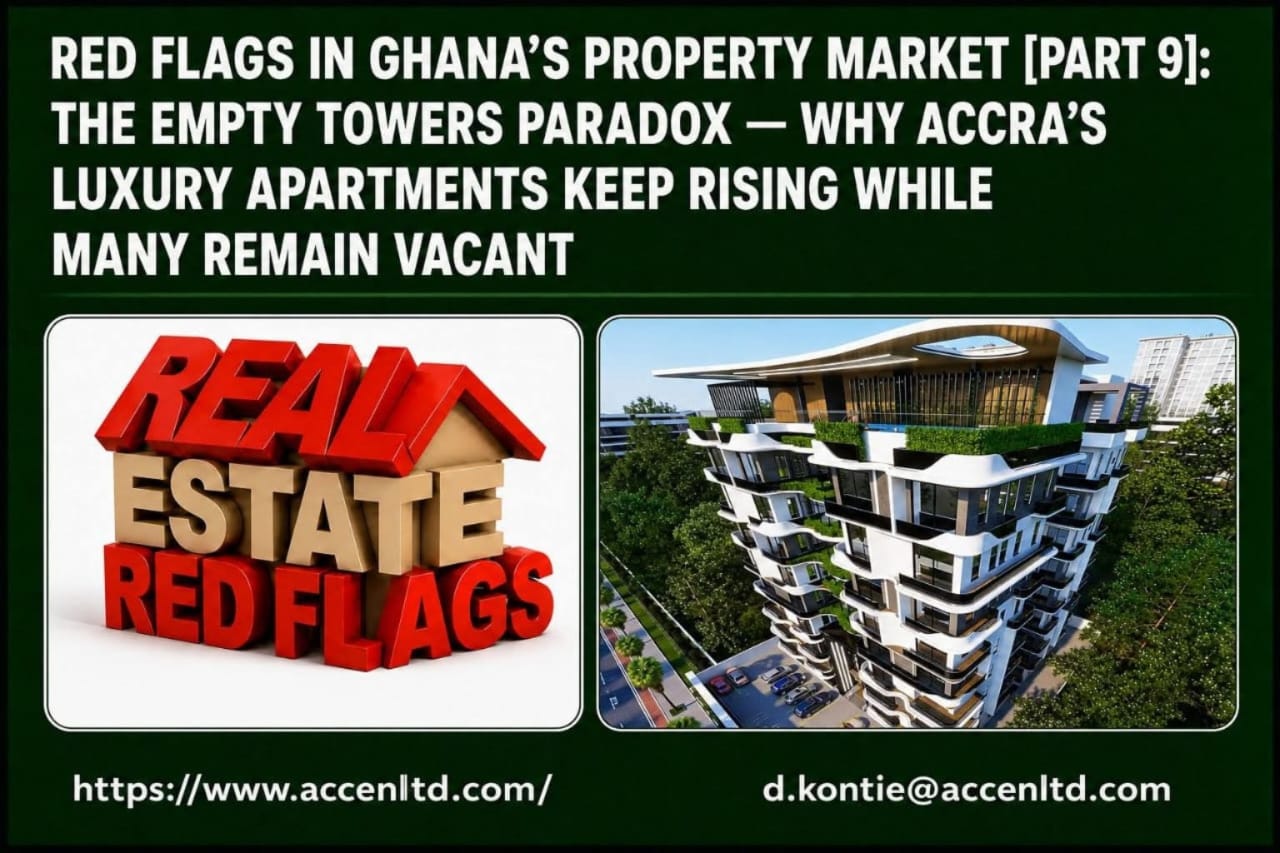
RED FLAGS IN GHANA’S PROPERTY MARKET [PART 9]: THE EMPTY TOWERS PARADOX – WHY ACCRA’S LUXURY APARTMENTS KEEP RISING WHILE MANY REMAIN VACANT
Across Cantonments, Airport Residential Area, Labone, Ridge, Osu, East Legon, Roman Ridge and several other prime districts in Accra, luxury apartment towers are rising at extraordinary speed. Glass façades now dominate areas once occupied by modest family homes. Rooftop lounges, concierge desks, infinity pools, gyms, sky bars and ultra-modern finishes have become the new symbols of prestige within Ghana’s evolving urban landscape.
The names of these developments often sound increasingly ambitious; “Residences,” “Heights,” “Pinnacle,” “Apex,” “Summit,” “Signature,” “Elite” etc. It appears developers are competing not only in construction, but also in branding sophistication. On the surface, this construction boom appears to signal prosperity, investor confidence and rapid urban transformation.
However, beneath the impressive skyline lies a contradiction that has become difficult to ignore. Drive through many of these areas after sunset and one observation becomes immediately apparent, many of these luxury apartment buildings remain strangely dark and visibly under-occupied.
In a country facing a housing deficit estimated at nearly two million units, how can apartments be everywhere while affordable housing remains out of reach for ordinary citizens? Why do prices continue to rise despite visible vacancy levels? Why are developers continuing to build luxury apartments at such an aggressive pace even when many existing units appear largely empty?
This contradiction exposes one of the most overlooked red flags in Ghana’s property market; the growing transformation of housing from a social necessity into a speculative financial asset and, in some cases, possibly a store of unexplained wealth.
In this article, I examine the growing paradox within Accra’s luxury real estate market, where rapid development of high-end apartment towers coexists with persistent vacancy and deepening housing shortages. I explore how economic instability, currency pressures, speculative investment behavior and weak transparency mechanisms may be reshaping housing from a basic social need into a financial asset class.
The analysis further considers the broader implications for affordability, urban inequality, legitimate developers and investors navigating an increasingly distorted property market. But before we go into the nitty-gritty of today’s discussion, let me remind you that, the Africa Continental Engineering & Construction Network Ltd stands out as one of Ghana’s leading real estate developers and consultants.
From land acquisition, title registration, architectural design, general construction, property development, real estate investment advisory services et cetera, we provide a 360º service experience. If you are ready to move from interest to investment, kindly visit our investment and property pages, explore available properties and reach out to our team for swift professional service delivery.
With thousands of serviced litigation-free parcels of land across Accra and key growth corridors, we are uniquely positioned to help you unlock value in residential, commercial and industrial real estate. Now, let us begin the discussion starting with this interesting paradox, the housing deficit amid empty.
Housing Deficit Amid Empty Apartments
Ghana continues to face a severe housing crisis. According to UN-Habitat (2024), Ghana’s housing deficit is estimated at between 1.8 and 2 million housing units. Despite decades of construction activity, the country continues to struggle with overcrowding, informal settlements and limited access to affordable housing.
Ordinarily, one would expect a massive housing shortage to create strong demand for any newly built housing stock. However, the reality in Accra’s luxury apartment market tells a very different story. Data from Ghana’s 2021 Population and Housing Census indicates that approximately 1.3 million dwelling units across the country remain vacant, with Greater Accra recording particularly significant vacancy levels in some high-income districts.
This creates a paradox that conventional economic theory struggles to explain. In a normal housing market, persistent oversupply should exert downward pressure on prices. However, in Accra’s luxury property segment, prices continue to escalate despite visible under-occupancy. The explanation lies in the fact that many of these apartments are not being purchased primarily for occupation.
Increasingly, they appear to be functioning as investment instruments, stores of wealth, speculative assets and long-term capital preservation vehicles. In essence, many apartments are being bought less as homes and more as financial vaults constructed in concrete and glass.
Why Luxury Apartments Continue to Rise despite Weak Occupancy
One of the major forces driving this phenomenon is Ghana’s broader economic environment. Over the years, the country has experienced repeated periods of inflation, cedi depreciation, banking sector instability and sovereign debt stress. In such environments, wealthy individuals naturally seek safer ways to preserve value.
For many investors, real estate appears more secure than leaving large sums within financial institutions or holding wealth in local currency. Property is viewed as tangible, inflation-resistant and capable of retaining dollar-equivalent value over time. This trend is particularly strong among diaspora investors, politically connected elites, high-net-worth individuals and foreign investors.
Unlike ordinary homebuyers who purchase property primarily for shelter, these categories of investors often purchase property for wealth preservation. Additionally, the increasing dollarization of Ghana’s luxury property market has intensified the problem. Many apartments in Cantonments, Airport Residential and Ridge are marketed and sold directly in US dollars rather than Ghana Cedis.
Consequently, prices become disconnected from local income realities and tied instead, to foreign currency expectations. This effectively excludes most Ghanaian salary earners from participating in the market. A teacher, nurse, civil servant or even many middle-level corporate professionals cannot realistically afford a studio apartment costing between US$200,000 and US$250,000.
The apartments therefore serve a narrow market segment while the broader housing needs of the population remain unresolved. Speculation also plays a major role. Many investors are willing to leave apartments vacant because they are not primarily interested in rental income. Their expectation is that the underlying land and property values will continue appreciating over time.
As long as prices rise, vacancy becomes financially tolerable. This creates a dangerous cycle; apartments remain empty, prices continue rising, speculation intensifies and genuine housing affordability worsens. Another sensitive and often discussed concern involves the possibility of illicit financial flows entering the property market according to Ghana Real Estate Developers Association (GREDA, Amegayibor, 2023).
Globally, luxury real estate markets in cities such as London, Dubai, Vancouver, Lagos and Johannesburg have faced scrutiny over their potential use in concealing unexplained wealth. However, it is important to emphasize that not every luxury apartment purchase is suspicious.
Many developments are legitimate commercial ventures but weak enforcement systems and insufficient transparency can create vulnerabilities that allow property markets to become channels for concealing wealth whose origins may not be fully explained.
Where regulatory oversight is weak, luxury real estate can gradually evolve into a parallel financial storage system operating outside meaningful scrutiny and this is exactly the situation we find ourselves as a country.
Consequences for the Ghanaian Economy
The rise of under-occupied luxury apartments carries significant economic implications for Ghana. One major consequence is the misallocation of capital. Vast sums of money are being directed into speculative high-end real estate rather than productive sectors such as manufacturing, agriculture, industrial processing, technology, infrastructure or export-oriented businesses.
While real estate contributes to economic activity, excessive concentration of investment in speculative property markets can weaken long-term productive growth. This becomes especially problematic when apartments are purchased merely to preserve wealth rather than generate economic activity through occupation, commerce or productive enterprise.
Another consequence is that the luxury apartment boom creates an illusion of progress while doing little to solve Ghana’s actual housing crisis. Construction cranes and glossy buildings may suggest housing sector growth, but if the majority of citizens cannot afford these units, then the social housing problem remains unresolved.
The result is a city where: luxury supply expands, affordability declines and housing inequality deepens. The boom also contributes to urban spatial segregation. Prime areas become increasingly inaccessible to ordinary Ghanaians as land prices escalate rapidly. Once luxury towers dominate a district, surrounding land values surge, rents rise and lower-income households are gradually displaced toward the urban periphery.
This process fuels urban sprawl, longer commuting times, traffic congestion, infrastructure pressure and increasing social inequality. There is also a broader financial implication. If wealthy individuals continue storing wealth in property rather than banks or productive investments, financial intermediation weakens.
Banks rely on deposits to provide loans that stimulate business expansion and economic growth. Excessive movement of capital into passive real estate assets can therefore reduce liquidity available for productive lending within the economy.
Consequences for Genuine Developers Using Legitimate Capital
Another overlooked consequence of suspicious capital inflows into luxury real estate is the unfair competitive environment it creates for genuine developers operating with legitimate sources of funding. Developers who raise capital transparently through; bank financing, private equity, shareholder contributions, mortgages or structured investment arrangements must operate based on commercial realities.
They depend heavily on occupancy rates, rental yields, sales velocity, debt servicing and realistic return on investment calculations. However, where portions of the market are potentially influenced by investors whose primary objective is merely to store or conceal wealth rather than generate genuine commercial returns, market pricing becomes distorted.
In such situations, some developers or investors may hold units vacant for long periods, ignore weak rental performance, maintain excessively high prices despite low occupancy or continue purchasing land at inflated values without immediate commercial pressure.
This creates a dangerous imbalance for legitimate developers because pricing no longer reflects normal market fundamentals. As a result genuine developers struggle to compete for land, construction costs escalate, access to prime locations becomes progressively difficult and commercially disciplined developers may eventually be pushed out of parts of the market.
Over time, this can discourage ethical and professionally managed real estate development while rewarding speculative or opaque capital behavior. The long-term danger is that the property market gradually loses its efficiency as a mechanism for productive investment allocation.
Consequences for Ordinary Citizens
For ordinary Ghanaian citizens, the consequences are severe and deeply personal. Housing affordability continues to deteriorate while incomes struggle to keep pace with property inflation. Many young professionals now face the reality that home ownership in prime urban locations has become almost impossible.
Even renting within many upscale districts is beyond the reach of middle-income earners because rental pricing is often benchmarked to US dollar values rather than local income conditions. As formal housing becomes unaffordable, more households are pushed into overcrowded compound housing, unregulated peri-urban developments and informal settlements. Many of these overcrowded compound housing are evident in areas such as Teshie, Nungua, Tsokor, Jamestown, Bukom, Kaneshie, Nima, Ashaiman, Gamashie just to mention a few.
This creates additional pressures on sanitation, drainage systems, transportation networks and public infrastructure. Beyond economics, the visible contrast between empty luxury towers and widespread housing hardship carries social consequences.
When citizens observe expensive buildings sitting vacant while many struggle to secure decent accommodation, perceptions of inequality and institutional unfairness intensify. The situation raises difficult questions about who the city is truly being built for, whose interests urban development serves and whether housing has gradually ceased to function primarily as shelter.
A Growing Risk for Unsuspecting Ghanaian Investors
Another important concern is the growing number of ordinary Ghanaian investors being drawn into luxury apartment investments under the assumption that prices will rise indefinitely. Many middle and upper-middle-income Ghanaians are increasingly purchasing luxury apartments for investment purposes after observing years of rapid property appreciation in prime areas of Accra.
Developers often market these projects aggressively using promises of high rental yields, guaranteed occupancy, continuous capital appreciation and strong expatriate demand. However, many investors fail to appreciate an important risk, a market driven heavily by speculation rather than genuine occupancy demand can eventually become unstable.
If supply continues rising significantly faster than actual end-user demand, several risks may emerge, for example, falling rental yields, prolonged vacancy periods, declining resale liquidity, rental oversupply and downward pressure on prices. An investor who purchases an expensive apartment primarily expecting constant appreciation may eventually discover that; tenants are difficult to secure, maintenance costs are rising, service charges are high and resale opportunities are weaker than anticipated.
This risk becomes even greater if future economic conditions weaken expatriate demand, tighten global capital flows or increase regulatory scrutiny over suspicious real estate transactions. In such circumstances, ordinary investors who entered the market late may bear the greatest financial losses
while early speculative investors exit profitably.
Historically, several global cities that experienced aggressive luxury property booms eventually encountered periods of price stagnation, oversupply or correction after speculative demand weakened.
For this reason, investors must evaluate luxury property acquisitions based not merely on hype or prestige, but on genuine occupancy demand, realistic rental performance, location sustainability, demographic trends and long-term economic fundamentals. Real estate remains a powerful investment class, but when speculation becomes disconnected from real housing demand, significant investment risks emerge.
Policy Recommendations: What Policymakers Must Do
The solution is not to discourage real estate development. Real estate remains an important contributor to employment, infrastructure growth and urban modernization. However, policymakers must ensure that the property sector serves both economic and social objectives.
This is precisely where coordinated and collaborative enforcement of the provisions of the Real Estate Agency Act, 2020 (Act 1047), the Anti-Money Laundering Act, 2020 (Act 1044), the Economic and Organized Crime Office Act, 2010 (Act 804) and the mandates of their respective regulatory and enforcement institutions has become more critical than ever.
In an increasingly complex property market environment, stronger inter-agency cooperation, regulatory vigilance and effective enforcement are essential to safeguarding market integrity, protecting legitimate investment and strengthening public confidence in Ghana’s real estate sector.
First, Ghana must strengthen anti-money laundering oversight within the real estate sector. Enhanced beneficial ownership disclosure, source-of-funds verification and stricter due diligence for politically exposed persons are essential.
Second, policymakers should consider carefully designed vacancy taxes on persistently unoccupied luxury apartments. Several global cities have implemented such measures to discourage speculative hoarding and encourage productive use of housing stock.
Third, government must aggressively promote affordable housing development. Incentives can be provided to developers who allocate portions of projects toward workforce and middle-income housing. Public-private partnerships, subsidized infrastructure support and tax incentives may assist in redirecting development toward genuine housing needs.
Fourth, housing finance systems require urgent reform. Mortgage access in Ghana remains extremely limited due to high interest rates and weak long-term financing structures. Expanding access to affordable housing finance is critical if ordinary citizens are to participate meaningfully in the formal housing market.
Fifth, Ghana must expedite action on improving land administration systems through digitization, title transparency and faster registration processes. A more transparent land system reduces speculation, enhances investor confidence and improves market efficiency.
Finally, the country must create stronger alternative investment opportunities outside real estate. Citizens should not feel compelled to preserve wealth almost exclusively through property acquisition. Expanding investment opportunities in productive sectors will reduce excessive speculative pressure on urban real estate markets.
Conclusion
The rapid rise of luxury apartment towers across Accra reflects more than architectural transformation. It reveals deeper structural realities within Ghana’s economy; wealth concentration, currency instability, speculative investment behavior, financial distrust, widening urban inequality and possible vulnerabilities to illicit financial flows.
The contradiction is impossible to ignore. In a country with a severe housing deficit, large numbers of luxury apartments remain visibly under-occupied while prices continue to rise beyond the reach of ordinary citizens.
This suggests that many apartments are no longer functioning primarily as homes but rather as investment instruments, speculative assets, wealth preservation vehicles and in some cases, potential storage spaces for unexplained capital.
At the same time, genuine developers operating transparently may find themselves competing against distorted market forces that do not obey normal commercial logic, while unsuspecting investors risk entering an overheated market based more on speculative expectations than sustainable occupancy demand.
If left unchecked, this trend risks deepening inequality, distorting urban development, weakening productive investment allocation and exposing ordinary investors to significant financial risk.
Accra’s skyline may continue to rise, but policymakers must ask an uncomfortable question, are these towers solving Ghana’s housing problem, or merely storing wealth behind glass walls and dark windows. Until that question is answered honestly, the empty towers paradox will remain one of the clearest red flags in Ghana’s property market.
References
- Financial Action Task Force (FATF) (2023). Money Laundering and the Real Estate Sector.
- Financial Intelligence Centre (FIC), Ghana (2025). Compliance and anti-money laundering monitoring reports.
- Ghana Statistical Service (2021). Population and Housing Census Report.
- Gyamfi, C. (2018). Bridging Urban Housing Deficit in Ghana: Challenges and Prospects of Private Sector Participation in Accra. University of Ghana.
- International Monetary Fund (IMF) (2023). Real Estate Markets, Financial Stability and Speculative Asset Inflation.
- Organisation for Economic Co-operation and Development (OECD) (2022). Housing Market Risks and Structural Vulnerabilities.
- UN-Habitat (2024). Ghana Housing Profile.
- World Bank (2020). Enhancing Government Effectiveness and Transparency: The Fight Against Illicit Financial Flows
- Amegayibor, S. (2023). GREDA raises concerns over illicit money infiltrating Ghana’s real estate sector. Business & Financial Times (B&FT), Accra, Ghana.
- Bank of Ghana (2024). Financial Stability Review.
About Author
Daniel Kontie is a young enthusiastic Ghanaian Entrepreneur, the Executive Chairman of the Africa Infrastructure Group; comprising the Africa Continental Engineering & Construction Network Ltd (ACECN), Falcon 48 Developers; Africa Infrastructure Energy and Africa Land Banking Investment Ltd. All these are growing establishments, disrupting the conventional way of brand building across the African Continent. Daniel is a columnist, a writer and a member of the Ghana Built Environment Writers Association. He can be contacted via Tel: +233209032280; Email: d.kontie@acecnltd.com; Website: https://acecnltd.com/.
Post Views: 605


Contact Details
- Accra Tema comm 26
- info@acecnltd.com
- +233 20 903 2280
© 2026 reserved AFRICAN CONTINENTAL ENGINEERING CONSTRUCTION NETWORK
Leave Your Comment