- +233209032280
- Monday to Friday: 9am to 5pm

RED FLAGS IN GHANA’S PROPERTY MARKET [PART 10]: THE HIDDEN COST TRAP - WHEN “AFFORDABLE LAND” BECOMES A FINANCIAL DRAIN - AFRICA CONTINENTAL ENGINEERING & CONSTRUCTION NETWORK
- Home
- RED FLAGS IN GHANA’S PROPERTY MARKET [PART 10]: THE HIDDEN COST TRAP – WHEN “AFFORDABLE LAND” BECOMES A FINANCIAL DRAIN
20May’26
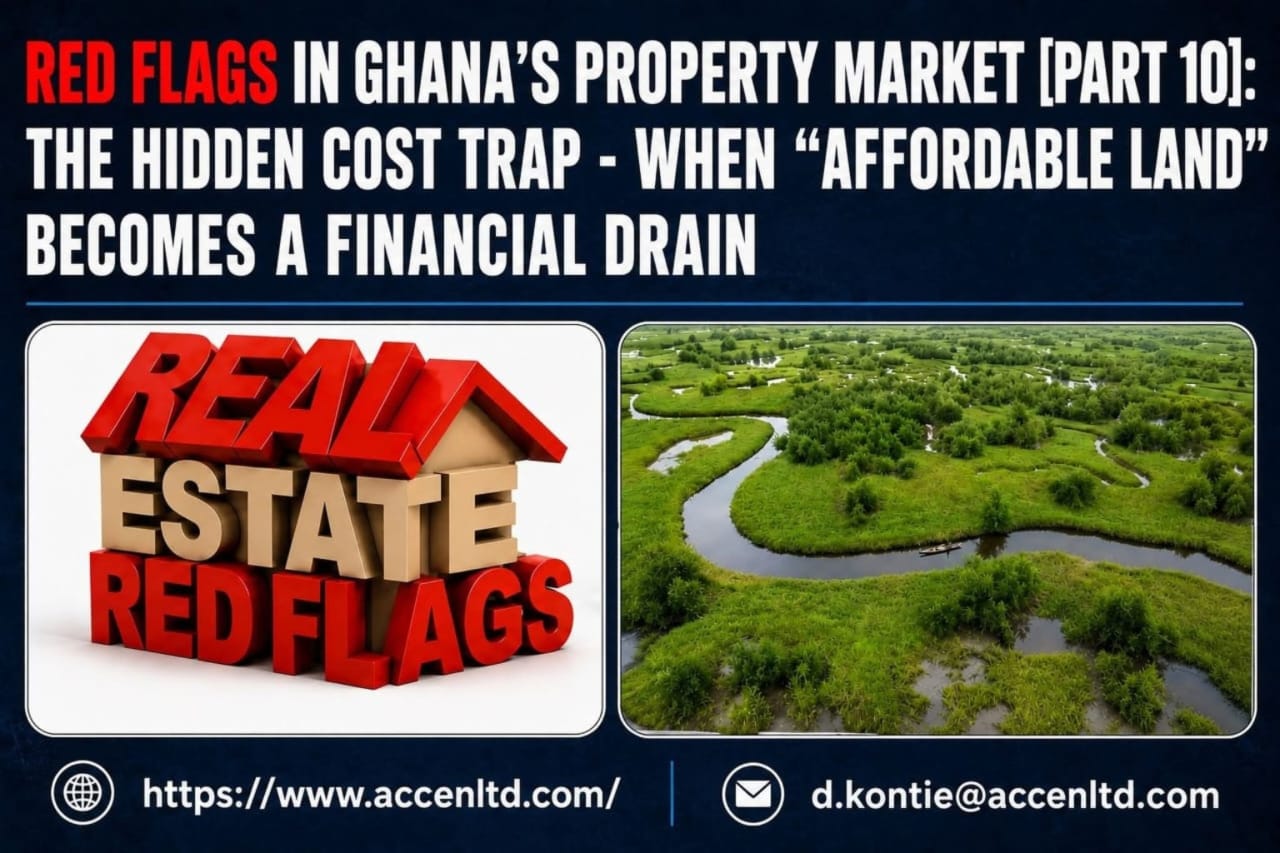
RED FLAGS IN GHANA’S PROPERTY MARKET [PART 10]: THE HIDDEN COST TRAP – WHEN “AFFORDABLE LAND” BECOMES A FINANCIAL DRAIN
One of the most dangerous misconceptions within Ghana’s property market is the assumption that “cheap land” automatically represents a smart investment opportunity. Across many emerging peri-urban and rural growth corridors, buyers are frequently attracted by relatively lower land prices without critically assessing the long-term financial implications attached to those lands.
In reality, some of the so-called “affordable lands” eventually become far more expensive than prime properties located within properly planned and development-ready areas. Within Ghana’s real estate environment, the hidden cost problem goes far beyond the mere absence of roads, electricity, drainage systems, or water supply infrastructure.
In fact, in many parts of Ghana, lands are often sold and fully acquired long before government infrastructure eventually reaches those locations. Therefore, the absence of immediate infrastructure alone does not necessarily make land cheap within the Ghanaian context. Rather, what happens in many situations is that certain lands are intentionally sold “cheaply” because the sellers already understand hidden environmental, engineering, accessibility, planning, drainage or litigation complications unknown to unsuspecting buyers.
The lower price therefore becomes a mechanism for transferring hidden future liabilities from informed sellers to uninformed purchasers. The true cost of land ownership is therefore not determined merely by acquisition price. It is significantly influenced by environmental suitability, legal security, physical accessibility, engineering conditions, planning compliance, drainage viability, development readiness and long-term marketability.
Unfortunately, many buyers focus primarily on purchase price while ignoring the enormous hidden capital burden required to make the land usable, legally developable, commercially viable, or physically accessible. In Ghana, this phenomenon has become increasingly visible across rapidly urbanizing areas surrounding Accra, Kumasi, Takoradi, Tamale and other expanding municipalities where speculative land acquisition often outpaces planning controls, technical due diligence and infrastructure coordination.
Buyers frequently discover years later that the supposedly “cheap land” has trapped them in prolonged financial commitments with little practical usability or resale potential. In this article, I examine one of the most overlooked realities within Ghana’s property market: the hidden financial dangers behind supposedly “affordable land” acquisitions.
The article explores how wetlands, Ramsar restrictions, poor planning, inaccessible layouts, unstable soil conditions, drainage complications, difficult topography and litigation risks often transform “cheap land” into long-term financial liabilities for unsuspecting buyers and investors.
But before we go into the nitty-gritty of today’s discussion, let me remind you that, the Africa Continental Engineering & Construction Network Ltd stands out as one of Ghana’s leading real estate developers and consultants. From land acquisition, title registration, architectural design, general construction, property development, real estate investment advisory services et cetera, we provide a 360º service experience.
If you are ready to move from interest to investment, kindly visit our investment and property pages, explore available properties and reach out to our team for swift professional service delivery. With thousands of serviced litigation-free parcels of land across Accra and key growth corridors, we are uniquely positioned to help you unlock value in residential, commercial and industrial real estate. Now, let us begin the discussion starting with the illusion of “Cheap Land”.
The Illusion of “Cheap Land”
In property economics, land value is not determined merely by size or geographical location but by utility, accessibility, environmental suitability, infrastructure support, planning integration, legal certainty and development feasibility. A parcel of land may appear strategically located on paper yet remain practically undevelopable because of hidden technical, environmental, or legal complications.
The World Bank emphasizes that land access alone is insufficient without integrated infrastructure systems, effective land governance and coordinated spatial planning frameworks capable of supporting productivity and urban functionality (World Bank, 2025). Similarly, UN-Habitat notes that poorly coordinated urban expansion and informal land development frequently generate long-term inefficiencies that undermine sustainability, investment security and urban resilience (UN-Habitat, 2025).
In Ghana, many low-cost lands are situated within environmentally sensitive areas, inaccessible layouts, unstable soil zones, unregulated settlements, or litigation-prone customary land jurisdictions where sellers often possess critical technical information unavailable to buyers at the time of acquisition.
Consequently, the initial savings associated with land acquisition are gradually erased through expensive engineering works, legal complications, accessibility problems, environmental restrictions, or infrastructure burdens that emerge later during the development process.
Restricted Lands and Ramsar Wetland Traps
One of the most dangerous hidden cost traps within Ghana’s property market is the sale of environmentally restricted lands and wetlands to unsuspecting buyers. In many situations, lands are deliberately sold cheaply because sellers already know that those lands fall within flood retention zones, wetlands, Ramsar-protected areas, ecological buffers, or environmentally sensitive corridors where development approvals may become extremely difficult or completely impossible.
Many buyers only discover these restrictions years later when they seek building permits, attempt land registration processes, or commence physical development activities. Ghana contains several internationally protected Ramsar sites under the Ramsar Convention, including the Sakumo Ramsar Site in Accra, the Densu Delta Ramsar Site in Accra, the Songor Lagoon Ramsar Site in Ada, and the Muni-Pomadze Ramsar Site near Winneba etc.
Despite the protected status of these environmentally sensitive areas, portions surrounding some of these zones continue to experience informal land transactions and speculative sales activities. Unsuspecting buyers are often attracted by the relatively cheaper pricing and the expectation of future appreciation. However, once technical assessments, permit applications, or regulatory reviews begin, they may discover severe environmental restrictions limiting development possibilities.
At that stage, resale itself becomes difficult because informed buyers, financial institutions, developers, consultants and regulatory authorities become reluctant to engage such lands. What initially appeared to be an affordable investment opportunity eventually becomes economically trapped capital.
Environmental management scholars continue to warn that unregulated encroachment into wetlands creates serious urban sustainability, drainage and flood management risks within rapidly urbanizing African cities (Amoako & Frimpong Boamah, 2015).
The Wetland and Soil Stabilization Burden
Another major hidden cost trap involves lands that, although not officially Ramsar-protected, consist of wetlands, reclaimed waterlogged areas, low-lying flood-prone zones, or unstable soil formations requiring substantial engineering intervention before development becomes feasible.
In many situations, sellers are fully aware that such lands require expensive technical works including massive earth filling, soil stabilization, deep foundation systems, drainage redesign, retaining structures, flood mitigation systems and geotechnical reinforcement. This is because of these hidden future costs, such lands are frequently sold at lower prices to attract unsuspecting buyers seeking affordable investment opportunities.
However, after acquisition, buyers later discover that making the land physically developable may cost several multiples of the original purchase price. In some situations, the engineering preparation costs may exceed ten times the value of the land itself.
Practical examples of such conditions can be found within parts of Weija, Ofankor, Lakeside, Ashiyie, Kasoa and certain low-lying sections of peri-urban Accra where developers and individual landowners have had to spend enormous sums on filling works, drainage systems, stabilization measures and flood control interventions before construction could safely commence.
Research on residential construction cost estimation and project delivery challenges within Ghana also highlights the widespread problem of underestimated development costs and incomplete technical assessment assumptions within the construction sector (Apaaboah, Opoku & GhanaHousePlanner Research Team, 2026).
From a professional development perspective, cheap land with unstable geotechnical conditions can ultimately become far more expensive than premium land possessing suitable engineering characteristics and proper development readiness.
The Hidden Drainage and Accessibility Trap
Another overlooked issue within Ghana’s property market involves lands affected by major storm drains, water channels, inaccessible layouts, or disconnected infrastructure systems. In some situations, lands are sold cheaply because sellers already understand that physical accessibility itself may require extremely expensive engineering solutions before any meaningful development can occur.
For example, some lands may have major storm-water drains passing directly between the property and the nearest accessible roadway. Under such circumstances, accessibility may only become possible through the construction of reinforced concrete bridges or major drainage crossing infrastructure.
Depending on engineering specifications, such bridge construction projects may cost hundreds of thousands or even millions of Ghana Cedis. Where government infrastructure expansion does not eventually address such accessibility barriers, the land may remain undeveloped for many years despite ownership. If the owner intends immediate development, the financial burden effectively shifts entirely onto the individual buyer.
This problem significantly affects construction logistics, financing opportunities, tenant attractiveness, development feasibility, resale demand and long-term marketability. In many situations, the land remains technically owned but practically unusable.
Hilly Topography and the Engineering Cost Explosion
Another major but underestimated hidden cost trap within Ghana’s land market involves lands situated within difficult topographical environments. Some lands are sold cheaply specifically because sellers already understand that the terrain itself creates severe future construction complications and unusually high engineering costs.
These lands may require extensive excavation, hill cutting, dredging, retaining walls, slope stabilization systems, massive filling works, steel reinforcement systems and specialized foundation engineering before stable and level building platforms can be achieved.
Practical examples of such terrain-related challenges can be observed around McCarthy Hills, Abokobi, Aburi, Akuapem Ridge and several hillside developments across Accra’s expanding urban corridors. Although some of these locations offer attractive scenery and future prestige potential, the hidden engineering costs associated with making the land physically suitable for construction can become extraordinarily high. Unsuspecting buyers often focus on the discounted acquisition price while underestimating the enormous technical implications associated with difficult terrain conditions.
Poor Planning and the Accessibility Failure Problem
One of the least discussed realities within Ghana’s urban development system is how weak planning enforcement and poor implementation of planning regulations can significantly undermine land usability and marketability. A land may technically possess a strategic location yet remain commercially unattractive because of poor accessibility planning or incomplete infrastructure integration.
Practical situations exist in Accra where otherwise valuable residential lands remain difficult to develop because planned access routes were either never implemented or poorly coordinated with surrounding infrastructure systems. In some cases, lands situated near major highways or prime developments become trapped behind storm drains or disconnected road networks, leaving residents with unsafe or highly inconvenient access arrangements.
Where the only available access requires reliance on high-speed highways before reconnecting into residential communities, both safety and residential attractiveness become negatively affected. Such planning failures significantly reduce buyer confidence, commercial viability, investment liquidity, residential attractiveness, development interest and resale demand.
This explains why some strategically located lands remain unsold for years despite strong urban growth occurring around them. Accessibility is therefore not merely a convenience issue. It is one of the strongest determinants of real estate functionality, liquidity and long-term investment performance.
Litigation-Based Cheap Land Sales
Another major hidden cost trap within Ghana’s property market involves lands intentionally sold cheaply because sellers are already aware of litigation risks, ownership disputes or unresolved customary land conflicts. In many situations, ownership disputes already exist before the land is sold. Multiple ownership claims may affect the property, family succession conflicts may remain unresolved, boundaries may be contested, court cases may already be pending or documentation inconsistencies may exist.
Knowing these underlying legal risks, some sellers deliberately reduce prices to attract unsuspecting buyers searching for “cheap opportunities.” The buyer becomes attracted by the lower acquisition cost without realizing that the discount itself may reflect hidden legal danger. Once disputes eventually emerge, the original seller may disappear, leaving the buyer trapped within years of litigation, financial losses, delayed development, emotional stress and uncertainty.
Studies on land administration and land rights documentation challenges in Ghana continue to identify ownership disputes, weak documentation systems, registration delays, overlapping customary claims and incomplete records as major constraints affecting land security and investment confidence (Borquaye, 2025; Abugri, 2021; ResearchGate Study, 2025). Within Ghana’s property market, unusually cheap land often requires unusually careful investigation.
Accessibility: The Silent Investment Killer
Accessibility remains one of the strongest determinants of real estate performance globally. A land may be geographically close to a major city yet economically disconnected because of poor transportation infrastructure, drainage barriers, incomplete road networks or planning failures. Accessibility directly affects construction logistics, commercial viability, financing opportunities, property appreciation, tenant attractiveness, resale demand and development feasibility.
When accessibility challenges persist for years, the investment gradually becomes economically stagnant. This explains why some lands acquired over a decade ago within speculative growth corridors still experience weak market demand despite nearby urban expansion. The inability to access the land conveniently significantly reduces both usability and liquidity.
The Resale Trap
One of the least discussed consequences of poorly located, inaccessible, environmentally restricted or technically problematic land is resale difficulty. Many investors assume land appreciation is automatic. However, appreciation without liquidity creates a dangerous illusion of wealth. A property may appear valuable on paper yet remain practically unsellable because informed buyers are unwilling to inherit engineering complications, wetland exposure, flood risks, litigation uncertainty, accessibility challenges, planning failures, drainage problems or infrastructure burdens.
The resale problem becomes even worse during economic downturns when buyers become increasingly selective and risk-sensitive. Within Ghana’s current property market, many investors are increasingly prioritizing serviced, accessible, legally secure and technically viable lands over speculative cheap plots carrying hidden future liabilities. Consequently, investors trapped within problematic locations often discover they cannot easily exit the investment despite years of ownership.
The Planning and Governance Dimension
The hidden cost trap is also closely connected to weaknesses within urban planning systems and land governance structures. The World Bank stresses that effective land administration systems, planning coordination, infrastructure integration and environmental management are essential for sustainable urban growth and functional property markets (World Bank, 2024; World Bank, 2025).
However, Ghana continues to face significant challenges including weak enforcement of development controls, fragmented customary land systems, inadequate spatial planning coordination, incomplete land data systems, poor infrastructure synchronization, manual land administration processes and speculative land transactions occurring ahead of technical planning assessments. Where planning systems remain weak, future development risks are frequently transferred onto unsuspecting buyers through speculative land sales.
What Smart Investors must Examine before Buying “Cheap Land”
Before purchasing land simply because it appears inexpensive, investors must critically assess the environmental status of the property, geotechnical conditions, accessibility viability, topographical suitability, planning compliance, drainage systems, legal security and actual marketability of the location.
Buyers must investigate whether the land falls within wetlands, flood-prone areas, Ramsar-protected zones, unstable soil formations, inaccessible layouts, litigation-prone customary jurisdictions or poorly planned settlements. Failure to conduct comprehensive technical, environmental, legal and planning due diligence can transform an apparently affordable acquisition into a long-term financial liability.
Conclusion
In Ghana’s property market, the “cheapest” land is not always the most affordable investment. In many situations, the lower price simply reflects hidden future liabilities already known by the seller but undiscovered by the buyer. These hidden risks may include wetland restrictions, Ramsar protection limitations, flood exposure, unstable soil conditions, severe engineering burdens, accessibility barriers, drainage complications, planning failures, litigation risks or infrastructure deficiencies.
What initially appears to be a discounted investment opportunity may ultimately require enormous financial resources simply to make the land usable, accessible, legally developable or commercially viable. Serious real estate investment therefore requires moving beyond emotional attraction to low pricing toward comprehensive technical, environmental, engineering, legal and planning due diligence before acquisition.
In property investment, the smartest purchase is not necessarily the “cheapest” land available, rather, it is the land that remains economically viable, legally secure, physically developable, accessible, marketable and sustainable throughout its ownership lifecycle, and within Ghana’s evolving property market, that distinction is becoming increasingly important.
References
- Abugri, E. A. (2021). We’re Digitizing ‘Problematic’ Land Acquisition Processes to Fight Corruption – Lands Commission.
- Amoako, C., & Frimpong Boamah, E. (2015). The Three-Dimensional Causes of Flooding in Accra, Ghana. International Journal of Urban Sustainable Development.
- Apaaboah, E., Opoku, B., & GhanaHousePlanner Research Team. (2026). A Parametric, Geometry-Aware Residential Construction Cost Estimation Model for Ghana. arXiv.
- Borquaye, E. (2025). Ghana’s Lands Commission: A Battle Against Corruption, Inefficiency, and Leadership Doubts. Ghana News Online.
- ResearchGate Study. (2025). Exploring Challenges of Land Rights Documentation in Abokobi and Kweiman Areas, Accra, Ghana.
- UN-Habitat. (2025). Participatory Slum Upgrading Programme (PSUP).
- World Bank. (2024). Land Research, Data, and Policy Insights.
- World Bank. (2025). Land: World Bank Group.
About Author
Daniel Kontie is a Ghanaian entrepreneur, real estate developer, infrastructure strategist and built environment thought leader. He is the Executive Chairman of the Africa Infrastructure Group, comprising Africa Continental Engineering & Construction Network Ltd (ACECN), Falcon 48 Developers, Africa Infrastructure Energy, and Africa Land Banking Investment Ltd. He is also a columnist, writer and a member of the Ghana Built Environment Writers Association. He can be contacted via Tel: +233209032280; Email: d.kontie@acecnltd.com; Website: https://acecnltd.com/.
Post Views: 524


Contact Details
- Accra Tema comm 26
- info@acecnltd.com
- +233 20 903 2280
© 2026 reserved AFRICAN CONTINENTAL ENGINEERING CONSTRUCTION NETWORK
Leave Your Comment