- +233209032280
- Monday to Friday: 9am to 5pm

RED FLAGS IN GHANA’S PROPERTY MARKET [PART 15]: THE REAL ESTATE AGENT MISINFORMATION TRAP - WHEN BUYERS ARE INFORMED BETTER THAN AGENTS WHO ARE SUPPOSED TO GUIDE THEM - AFRICA CONTINENTAL ENGINEERING & CONSTRUCTION NETWORK
- Home
- RED FLAGS IN GHANA’S PROPERTY MARKET [PART 15]: THE REAL ESTATE AGENT MISINFORMATION TRAP – WHEN BUYERS ARE INFORMED BETTER THAN AGENTS WHO ARE SUPPOSED TO GUIDE THEM
30Jul’26
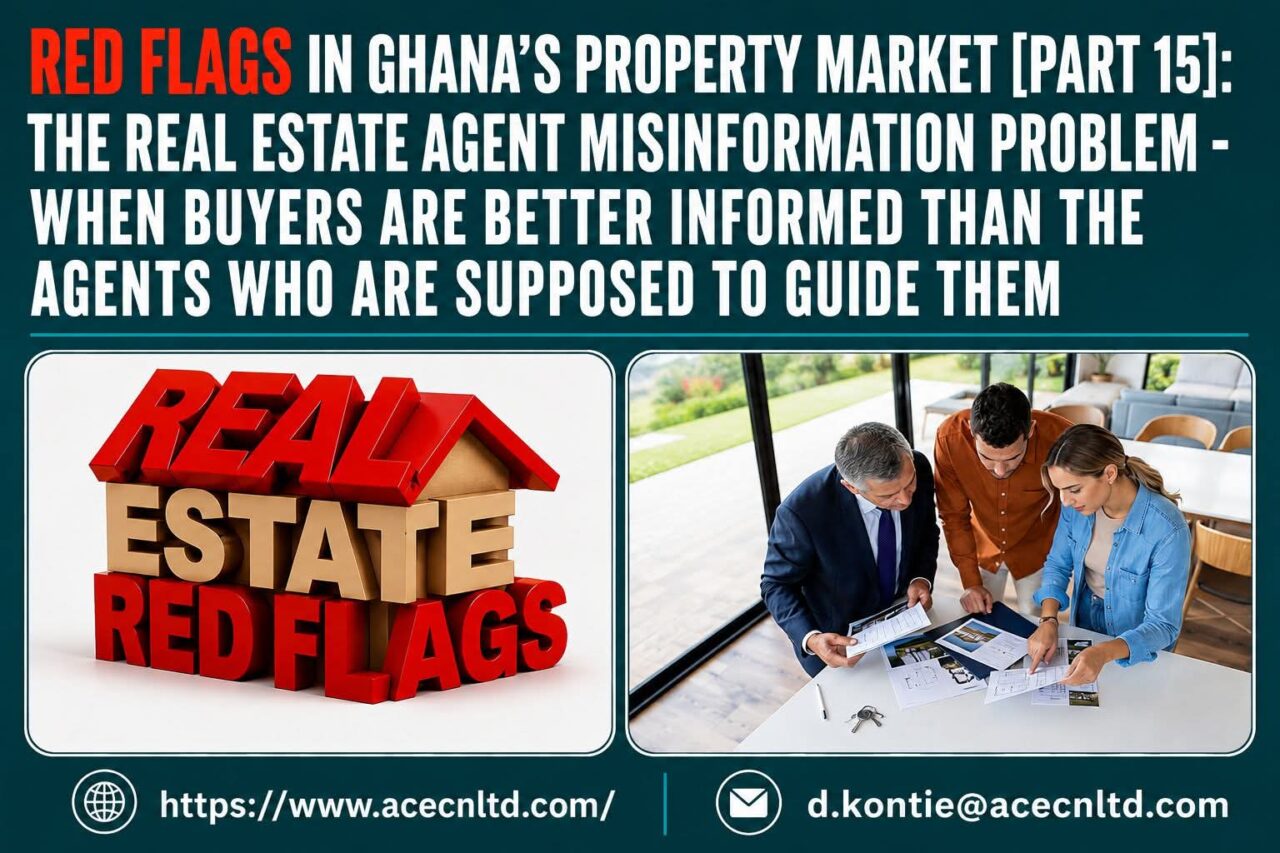
RED FLAGS IN GHANA’S PROPERTY MARKET [PART 15]: THE REAL ESTATE AGENT MISINFORMATION TRAP – WHEN BUYERS ARE BETTER INFORMED THAN AGENTS WHO ARE SUPOOSED TO GUIDE THEM
In Ghana’s property market today, one of the most underestimated risks is not the land itself, nor even the seller but the person standing in the middle of the transaction (agent). Across Accra and other rapidly expanding peri-urban areas such as Kumasi, Takoradi, Cape Coast, Tamale, Sunyani et cetera, a recurring pattern has emerged.
Many buyers consistently encounter agents who cannot clearly explain what they are selling. In some cases, they misstate ownership structures, misrepresent land status, or rely entirely on what they have been told by the supposed owner rather than what has been independently verified through official records.
In this article, I examine one of the most overlooked yet increasingly dangerous risks in Ghana’s property market. This is what I call the “Real Estate Agent Misinformation Trap”, the widespread problem of misinformation by real estate sales agents. I explore why many agents lack the legal and technical knowledge required to guide property transactions, how this knowledge gap exposes buyers to costly mistakes and disputes, why the problem persists despite recent regulatory reforms, and the practical steps every buyer should take to protect their investment.
Whether you are purchasing land for the first time or expanding your real estate portfolio, understanding this “agent misinformation trap” could save you from one of the most expensive mistakes in Ghana’s property market. But before we go into the nitty-gritty of today’s discussion, let me remind you that, the Africa Continental Engineering & Construction Network Ltd stands out as one of Ghana’s leading real estate developers and consultants.
From land acquisition, title registration, architectural design, general construction, property development, real estate investment advisory services et cetera, we provide an end-end real estate service experience. If you are ready to move from interest to investment, kindly search on Google, “Africa Continental Engineering & Construction Network Ltd”, visit our investment and property pages, explore available properties and reach out to our team for a swift professional service delivery.
With thousands of serviced litigation-free parcels of land across Accra and key growth corridors, we are uniquely positioned to help you unlock value in residential, commercial and industrial real estate. Now, let us go into the substantive discussion starting with “when agents are not actually professionals”.
When “Agents” are not Actually Professionals
Despite reforms introduced under the formal regulatory framework of the Real Estate Agency Council (REAC) and the Ghana Real Estate Agency Act, 2020 (Act 1047), the operational reality in Ghana’s property market still reflects a fragmented and largely informal brokerage system. In practice, individuals continue to operate as property brokers without formal licensing.
Many “agents” function merely as marketers or intermediaries for landowners, rather than trained professionals bound by regulatory standards. Brokerage is frequently learned informally through observation rather than structured training and commission incentives often override verification discipline. This creates a situation where the person facilitating a transaction may not possess the technical competence required to interpret land documentation or verify ownership status properly.
How Misinformation Manifests in Real Transactions
The misinformation trap in Ghana’s property market is rarely obvious at the outset of a transaction. Instead, it often emerges through seemingly routine interactions between buyers, sellers and property agents, where inaccurate, incomplete or unverified information is presented as fact. This is because, many buyers assume that agents possess the necessary expertise to guide them, they may accept these representations without independent verification.
Understanding how misinformation manifests in real estate transactions is therefore essential to recognizing potential warning signs, avoiding costly mistakes and making informed investment decisions. The following are some of the most common ways in which this problem presents itself in practice.
Misrepresentation of Ownership Status: A common scenario in the market begins with confident but unverified statements such as: “This land belongs to a family, everything is in order, and we are processing documents”. However, further investigation often reveals more complex realities. The land may be subject to litigation, part of a jointly owned stool or family property, or have already been sold multiple times to different buyers.
In many cases, agents rely solely on information provided by sellers without conducting independent verification through the Lands Commission or checking for encumbrances, competing claims, or court injunctions.
The “Confident Ignorance” Problem: A particularly dangerous feature of the misinformation trap is what can be described as confident ignorance. Many agents present information with high certainty while lacking technical understanding of land documentation. This includes situations where indentures are incorrectly assumed to be conclusive proof of ownership, site plans are mistaken for registered title documents, possession is equated with legal ownership while payment is interpreted as validation of legitimacy. This gap between confidence and competence creates a false sense of security for buyers, particularly, first time buyers.
Overreliance on Verbal Assurances: Another widespread issue is the heavy dependence on verbal assurances such as, the land is free from litigation, there are no family disputes, Government has no interest here et cetera. These statements are often repeated without documentary backing. However, in Ghanaian property disputes, verbal assurances carry little to no legal weight when conflicts arise. Courts consistently prioritize documentary evidence, registered interests and verifiable records over informal statements.
The Structural Root of the Problem
The widespread misinformation observed in Ghana’s real estate market is not merely the result of individual misconduct or incompetence; it is largely a product of deeper structural and institutional weaknesses that have evolved over time. Understanding these underlying factors is essential to appreciating why the problem persists despite legal reforms and growing public awareness. The following are some of the key structural drivers of the misinformation trap.
Informal Entry into Real Estate Brokerage: For decades, real estate brokerage in Ghana operated without a formal licensing regime. There were no standardized qualifications, no mandatory training structures and limited regulatory oversight. This allowed virtually anyone to enter the brokerage space and operate as an “agent.” Over time, this informal entry system became normalized.
Rapid Urban Expansion Outpacing Regulation: The rapid expansion of Greater Accra and surrounding urban corridors created intense demand for property intermediaries. As urbanization accelerated, informal brokers filled the gap faster than regulatory institutions could respond. Landowners also increasingly preferred quick, informal intermediaries capable of closing transactions rapidly, often bypassing formal documentation processes.
Weak Due Diligence Culture Among Buyers: Historically, many buyers relied heavily on trust, referrals and urgency-driven decision-making. Phrases such as “land will finish soon” became psychological triggers that encouraged rushed purchases without proper verification. This environment created fertile ground for misinformation and misrepresentation.
Why the Problem Still Persists Despite the Law
The introduction of the Ghana Real Estate Agency Act, 2020 (Act 1047) and the establishment of REAC marked a significant reform milestone. However, several structural challenges continue to limit its effectiveness.
Slow Licensing Penetration: A large portion of individuals actively operating as agents remain outside the formal licensing framework. As a result, the informal system continues to dominate significant segments of the market.
Limited Public Awareness: Many property buyers are unaware that, real estate brokerage is now a regulated profession, agents are required to be licensed, verification mechanisms exist to confirm legitimacy etc. This information gap allows unlicensed operators to continue functioning without scrutiny.
Enforcement Capacity Gaps: Although the regulatory framework exists, enforcement remains inconsistent. Monitoring informal market activity is inherently difficult and sanctions are not always visible or deterrent enough to change behavior at scale.
What the Law Actually Intends
Under the Ghana Real Estate Agency Act, 2020 (Act 1047), real estate brokerage is formally recognized as a regulated profession. Practitioners are required to obtain licenses, adhere to professional standards and comply with disciplinary procedures established by the Real Estate Agency Council (REAC).
The law is designed to ensure that intermediaries in property transactions are competent, accountable and traceable. In principle, this framework directly addresses the misinformation and unqualified brokerage practices currently observed in the informal market, however, legal intent and practical enforcement remain misaligned.
The Real Cost of Agent Misinformation
The consequences of misinformation in real estate transactions are significant and often long-lasting. Buyers may end up purchasing disputed land, entering prolonged litigation, or discovering that their investments are tied to encumbered or non-transferable property. In severe cases, developments are demolished following legal disputes and capital becomes locked in unresolved ownership conflicts for years. The broader effect is a gradual erosion of trust in the property market.
What must Change Immediately
Addressing the real estate agent misinformation trap requires both stronger institutional reforms and a fundamental shift in industry practice. First, no property transaction should proceed without independent verification through Lands Commission searches, confirmation of ownership documentation and review of site plan registration status.
Any agent who discourages or attempts to bypass these verification processes should be regarded as a significant red flag. In addition, the regulatory framework under the Real Estate Agency Council (REAC) must be more rigorously enforced to ensure that only licensed practitioners are permitted to operate, with visible sanctions imposed on those who violate the law.
Equally important is the professionalization of real estate brokerage through standardized training, legal literacy in land documentation and mandatory continuing professional education. At the same time, buyers must recognize that agents are facilitators of property transactions, not authoritative sources of truth regarding ownership or legal status. Independent due diligence should therefore remain the cornerstone of every property acquisition decision.
What Buyers must do to Protect Themselves
Before making any payment, buyers should, independently verify ownership at the Lands Commission by conducting formal land searches on title, request and authenticate original documentation, conduct rigorous title root search, search on litigation history and encumbrances et cetera and also confirm whether the agent is licensed under REAC if the transaction involves an agent, whilst avoiding decisions driven by urgency or pressure and never rely solely on verbal assurances for property transactions.
A Guide to Starting the Process
One of the biggest challenges for buyers is how to bring all these checks together without wasting time or increasing costs. A more effective approach is to engage a qualified real estate consultant or legal professional who can coordinate the entire due diligence process. Instead of dealing separately with surveyors, lawyers and planners, the buyer works with a central expert who manages everything.
This approach reduces risk, prevents costly mistakes and ensures that all necessary checks are properly carried out in the right order. This is where the expertise of the Africa Continental Engineering & Construction Network Ltd becomes valuable.
At our firm, due diligence goes far beyond the standard checks. In addition to title verification, we conduct title root tracing, litigation history searches, encumbrance checks and collateral registry reviews. We also gather on-the-ground information through community engagement, recognizing the fact that, some important insights are often not captured in official records.
As a final step in the case of land acquisition, we may test possession through controlled site activities such as clearing, hoarding or tipping a trip of sand or chippings et cetera to uncover any hidden disputes. This comprehensive approach has helped identify issues that routine checks often cannot. However, do not try this controlled site possession checks because it involves risks and should always be handled by our team of experienced professionals.
Conclusion
In conclusion, the most dangerous element in Ghana’s property market is no longer simply fraudulent sellers, but the normalization of unlicensed intermediaries operating as professionals. Until regulatory enforcement fully aligns with legal reforms and until buyers adopt a verification-first mindset, the misinformation trap will remain one of the most persistent and costly risks in the sector.
In real estate transactions, authority should never be assumed, it must be proven and in Ghana’s property market, proof lives in documents, not in confidence. See you in part 16 but remember, the oldest admonition in property transactions still remains, “Caveat Emptor” (Buyer Beware!).
References
- Ghana Real Estate Agency Act, 2020 (Act 1047), Government of Ghana
- Real Estate Agency Council (REAC) official regulatory framework and licensing guidelines
- Lands Commission of Ghana procedures on land search and title verification
- Principles of Ghanaian land law and evidentiary standards in property dispute adjudication
- Ministry of Works and Housing policy frameworks on real estate regulation reforms in Ghana
About Author
Daniel Kontie is a Ghanaian entrepreneur, real estate developer, infrastructure strategist and built environment thought leader. He is the Executive Chairman of the Africa Infrastructure Group, comprising Africa Continental Engineering & Construction Network Ltd (ACECN), Falcon 48 Developers, Africa Infrastructure Energy, and Africa Land Banking Investment Ltd. He is also a columnist, writer and a member of the Ghana Built Environment Writers Association. He can be contacted via Tel: +233209032280; Email: d.kontie@acecnltd.com; Website: https://acecnltd.com/.
Post Views: 23


Contact Details
- Accra Tema comm 26
- info@acecnltd.com
- +233 20 903 2280
© 2026 reserved AFRICAN CONTINENTAL ENGINEERING CONSTRUCTION NETWORK
Leave Your Comment