- +233209032280
- Monday to Friday: 9am to 5pm

RED FLAGS IN GHANA’S PROPERTY MARKET [PART 8]: THE “PAY AGAIN” LAND ACQUISITION TRAP - HOW DELAYED REGISTRATION EXPOSES BUYERS TO PAY TWICE FOR LAND THEY HAVE ALREADY PAID FOR AFTER A GRANTOR’S DEATH - AFRICA CONTINENTAL ENGINEERING & CONSTRUCTION NETWORK
- Home
- RED FLAGS IN GHANA’S PROPERTY MARKET [PART 8]: THE “PAY AGAIN” LAND ACQUISITION TRAP – HOW DELAYED REGISTRATION EXPOSES BUYERS TO PAY TWICE FOR LAND THEY HAVE ALREADY PAID FOR AFTER A GRANTOR’S DEATH
14May’26
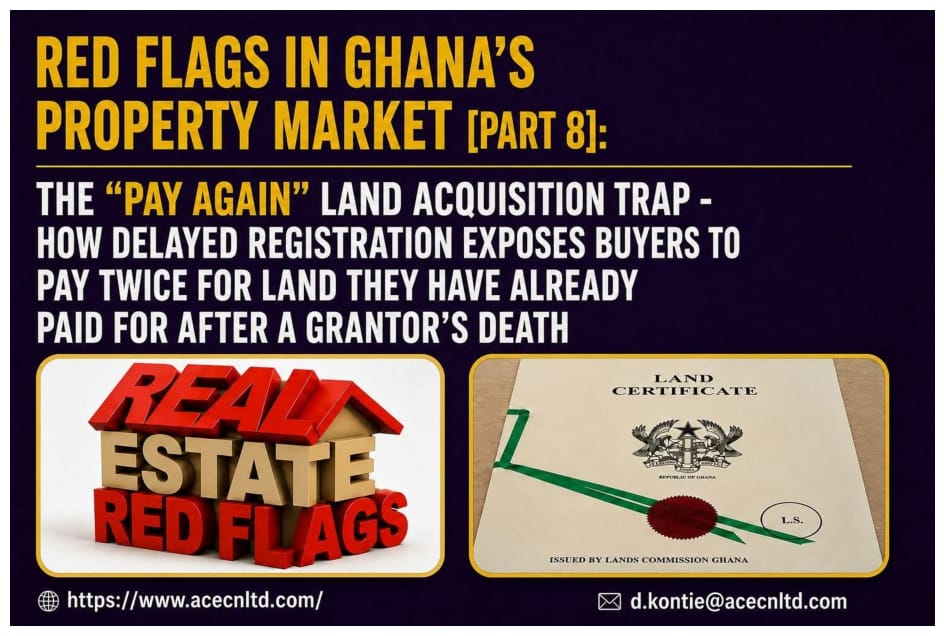
RED FLAGS IN GHANA’S PROPERTY MARKET [PART 8]: THE “PAY AGAIN” LAND ACQUISITION TRAP – HOW DELAYED REGISTRATION EXPOSES BUYERS TO PAY TWICE FOR LAND THEY HAVE ALREADY PAID FOR AFTER A GRANTOR’S DEATH
In Ghana’s customary land market, one of the most underestimated risks confronting buyers today is not only double sale, boundary disputes, litigation or land guard activities. Alarmingly, another dangerous but less discussed phenomenon is emerging, the succession trap created by delayed land registration.
If you, reading this article, have purchased or acquired customary land in Ghana and have still not registered your interest with the Lands Commission for whatever reason and that land is still undeveloped or not possessed, you may be sitting on a serious future risk without realizing it.
If I am in the position to advise you, I would edge you to pick up your indenture and begin the registration process immediately before a sudden death, succession dispute, change in family leadership or customary transition turns your legitimate ownership into a painful financial and legal battle.
For many buyers across Ghana, the delay they once considered harmless has later become one of the biggest regrets of their investment journey.
Across Ghana, many land buyers acquire land from chiefs, family heads, clans, stools or customary grantors and receive documents such as indentures, allocation notes, site plans, receipts and land purchase agreements.
However, many fail to immediately regularize and register their interests with the Lands Commission. Some postpone registration because they do not intend to immediately develop the land, while others become frustrated by administrative delays and abandon the process halfway.
Unfortunately, this delay is becoming one of the biggest structural red flags in Ghana’s property market. What many buyers fail to appreciate is that, possession of land documents alone does not automatically secure ownership against future challenges. In many instances, buyers only begin to expedite registration when they sense danger, insecurity or possible competing claims over the land.
By then, however, many discover that the original grantor has died, succession disputes have emerged or authority over the land has changed hands.
At that point, the successor or next of kin whose signature is required to complete registration may refuse to cooperate unless the buyer renegotiates the land price or pays fresh charges before documents are endorsed. In effect, some buyers are compelled to “buy their own land again” years after legitimately acquiring it.
This disturbing trend is increasingly common in Ghana’s land market and deserves urgent national attention because it exposes deep weaknesses in customary land administration systems, transaction documentation and registration enforcement mechanisms.
In this article, I examine this dangerous but overlooked risks within Ghana’s customary land market, the growing phenomenon where land buyers are forced to renegotiate or make fresh payments for lands they legitimately purchased years earlier simply because registration was delayed until after the death of the original grantor.
I explore how succession disputes, weak customary land administration systems, bureaucratic registration delays and poor transaction documentation are exposing buyers to extortion, ownership insecurity and costly legal battles, while also outlining the urgent steps buyers, policymakers and traditional authorities must take to protect land ownership rights and restore confidence in Ghana’s property market.
But before we go into the nitty-gritty of today’s discussion, let me remind you that, the Africa Continental Engineering & Construction Network Ltd stands out as one of Ghana’s leading real estate developers and consultants. From land acquisition, title registration, architectural design, general construction, property development, real estate investment advisory services et cetera, we provide a 360º service experience.
If you are ready to move from interest to investment, kindly search us on Google, visit our investment and property pages, explore available properties and reach out to our team for swift professional service delivery. With thousands of serviced litigation-free parcels of land across Accra and key growth corridors, we are uniquely positioned to help you unlock value in residential, commercial and industrial real estate. Now, let us begin the discussion starting with the growing reality in Ghana’s land market.
The Growing Reality in Ghana’s Land Market
The pattern is becoming alarmingly familiar across Ghana. A buyer acquires land from a family, stool, clan or customary authority and receives the relevant transactional documents. The buyer assumes ownership is secure and postpones registration indefinitely. Years later, the original grantor passes on; family leadership changes or succession disputes arise.
The buyer then attempts to regularize the land interest only to discover that fresh signatures or confirmations are required from successors or family representatives before the Lands Commission can proceed with registration.
In many cases, the successor challenges the transaction and demands proof beyond the buyer’s existing documents. Some claim they never benefited from the original sale and therefore insist on fresh payment negotiations before signing. Others deny knowledge of the transaction entirely or exploit the situation to extort additional money from the buyer. This phenomenon has become one of the hidden but dangerous structural defects within Ghana’s property market.
The problem is particularly severe because approximately 80 percent of land in Ghana is held under customary ownership systems involving stools, skins, clans and families. Consequently, land transactions are often deeply tied to individuals and customary authority structures rather than fully institutionalized administrative systems.
This creates significant vulnerability whenever succession, death, or leadership transitions occur. Sharing a practical experience, in 2014, a renowned Accra-based developer (name withheld) I worked with acquired parcels of customary land in Kaosa, that had not yet been formally registered and subsequently allocated portions of it to staff as long-service and loyalty incentives.
However, many of the beneficiaries did not immediately take steps to perfect their interests through registration. Seven years later, one staff member who intended to exit the company sought to regularize his title. At that point, he was informed that the original customary grantor had passed on.
He was then introduced to a purported next of kin of the deceased grantor who asserted control over the original transaction and demanded fresh negotiations and additional payments before consenting to the registration of the land interest. This is not a theoretical illustration drawn from literature. It reflects a lived reality and a recurring risk within Ghana’s customary land sector, one that urgently requires closer attention.
Why this is a Major Red Flag in Ghana’s Property Market
Customary Land Transactions Remain Excessively Personality-Dependent: One of the biggest structural weaknesses in Ghana’s land administration system is that, many customary land transactions depend heavily on individuals rather than institutional continuity.
In many communities, the authority to allocate or confirm land rights may revolve around a chief, family head, principal elder, or clan representative. When such individuals die, destooled or replaced, disputes often emerge regarding earlier transactions.
Under the Land Act, 2020 (Act 1036), Ghana has attempted to strengthen customary land governance through mechanisms such as Customary Land Secretariats intended to improve record keeping and transparency. However, implementation remains inconsistent across many customary areas, leaving buyers exposed whenever succession disputes arise.
Where transactions are poorly documented or inadequately institutionalized, successors can more easily challenge previous grants, deny knowledge of transactions or demand additional payments before cooperating with registration processes.
Delay Weakens the Buyer’s Legal Position: A dangerous misconception in Ghana’s property market is the belief that possession of an indenture alone guarantees secure ownership forever. In reality, registration plays a critical role in strengthening enforceability, establishing priority of interests and protecting buyers against future competing claims.
The Lands Commission Ghana has repeatedly emphasized that land registration is compulsory under Ghana’s land administration framework and that priority is often determined by the order in which applications are lodged and processed. Delayed registration therefore exposes buyers to, competing claims, double sale risks, fraudulent reallocation, succession disputes and evidentiary difficulties years later. The longer registration is delayed, the more vulnerable the buyer becomes.
Death of Grantors Creates Opportunity for Extortion: One of the most troubling aspects of this issue is the rise of informal extortion linked to succession disputes. Successors frequently argue that they did not personally benefit from the original sale and therefore refuse to cooperate unless fresh payments are made. In practice, many buyers become trapped between protecting their investment and avoiding lengthy litigation.
This creates a dangerous environment where land ownership becomes dependent not on the legitimacy of the original transaction but on the willingness of successors to honor the commitments of deceased grantors. Such uncertainty undermines confidence in Ghana’s land market and weakens the reliability of customary land transactions.
Bureaucratic Delays at the Lands Commission Worsen the Problem: Administrative inefficiencies within the land registration system also contribute significantly to the problem. Many buyers who initially attempt registration become discouraged by, long processing times, repeated corrections, missing files, plotting inconsistencies, survey disputes and bureaucratic bottlenecks.
As a result, some abandon the process midway and postpone completion indefinitely. Unfortunately, these delays increase the likelihood that the original grantor may die or succession disputes may emerge before registration begin or is finalized.
Weak Documentation Practices Continue to Endanger Buyers: Another major contributor to this problem is weak transaction documentation. Some buyers fail to verify the authority of grantors, confirm family consent, conduct proper land searches, engage lawyers or licensed surveyors or ensure proper witness authentication.
In some cases, transactions are conducted largely on trust without adequate legal safeguards. Where documentation is weak, successors can more easily dispute transactions and challenge the legitimacy of the buyer’s claim. This is precisely why experts continue to emphasize the importance of proper due diligence and immediate registration after acquisition (Ubink & Quan, 2008).
Why this Problem Matters Beyond Individual Buyers
The implications of this issue extend far beyond individual buyers. Land insecurity affects investor confidence, mortgage financing, infrastructure development, urban planning, diaspora investment and national economic growth. No property market can function efficiently where ownership rights remain vulnerable to succession politics and informal renegotiation years after purchase.
Uncertainty in land ownership also contributes to increased litigation, speculative disputes, stalled developments and reduced investor confidence. In economies where land administration systems are weak, transaction costs rise significantly and productive investment becomes constrained (World Bank, 2018). For Ghana, where land remains central to economic activity and infrastructure development, these weaknesses pose serious long-term development risks.
What Buyers Must Do Immediately
Register Land Interests Immediately After Acquisition: The most important protection available to buyers is immediate registration. Buyers must treat registration not as an optional administrative process but as an essential component of securing ownership rights.
Conduct Proper Due Diligence Before Purchase: Buyers should conduct searches at the Lands Commission; verify litigation status, confirm grantor authority, obtain proper family or stool consent and engage qualified lawyers, surveyors or real estate professionals before completing transactions.
Avoid Informal Cash-Based Transactions: Every land transaction should be supported by properly executed indentures, receipts, witness authentication, valid site plans, and legal verification.
Ensure Transactions are Properly Recorded: Where available, buyers should ensure transactions are recorded with relevant Customary Land Secretariats as encouraged under the Land Act, 2020 (Act 1036).
What Policymakers Must Do
Accelerate Digitization of Land Administration: Government must urgently modernize land registration systems, deed verification processes, digital archives, biometric authentication systems and succession-linked land records.
Strengthen Enforcement Against Successor Exploitation: The legal system must provide clearer protections against situations where successors exploit completed transactions to demand unauthorized additional payments.
Improve Public Education on Land Registration: Public education campaigns are urgently needed to help citizens understand the dangers of delayed registration, the difference between purchase and perfected title and the legal risks associated with unregistered interests.
Strengthen Accountability Within Customary Land Governance: Traditional authorities and customary land-owning families must institutionalize transparent transaction recording systems that survive beyond individual office holders.
Conclusion
In conclusion, the growing incidence of successors demanding fresh payments before signing registration documents is not merely an isolated inconvenience. It is a serious structural warning sign exposing deeper weaknesses within Ghana’s land administration system.
Many buyers only discover the danger after the original grantor dies, family leadership changes, or disputes emerge. By then, the financial and legal cost of regularizing ownership becomes significantly higher.
In Ghana’s property market today, delayed land registration is no longer a harmless administrative oversight. It is a major investment risk capable of turning legitimate ownership into prolonged uncertainty and vulnerability.
For buyers, investors, policymakers, traditional authorities, lawyers, surveyors and regulators alike, the lesson is crystal clear: In Ghana’s land market, ownership delayed can become ownership endangered or out rightly denied.
A Guide to Starting the Process
This sounds very scary, right?. Do not be scared, we are here to answer that multi-million dollar question of how one will be able to put together all the pieces of relevant information or the professionals needed to conduct a comprehensive due diligence whilst saving time and cutting cost.
A prudent property acquisition process must begin with the engagement of a reputable real estate consultant or a real estate legal practitioner who serves as the central coordinator of all pre-purchase and transaction requirements.
This takes away from the buyer, the burden of having to source individually, surveyors, legal practitioners, planners and other professionals relevant to the process. The consultant synchronizes these services, ensuring that the due diligence is properly sequenced, verified and professionally conducted.
This coordinated approach significantly reduces risk; curtail cost overruns and procedural errors, while providing the buyer with clarity and confidence throughout the process. This is where the expertise of the Africa Continental Engineering & Construction Network Ltd comes to play.
Our due diligence extends far beyond conventional Lands Commission searches. In addition to standard title verification, we undertake comprehensive title root tracing, litigation history checks, encumbrance searches and collateral registry reviews.
We also incorporate on-the-ground intelligence through discreet community engagement, recognizing that critical insights often reside outside formal records. As a final validation step, we test possession by initiating controlled site activity, such as clearing or minor works, to surface any latent disputes.
This layered and unconventional approach has enabled us to uncover hidden litigations and competing claims that routine searches may miss. However, such processes carry inherent risks and should not be attempted without professional guidance, engage our team to navigate them safely and effectively on your behalf. Speak to us now for guidance!
References
- Kasanga, K., & Kotey, N. A. (2001). Land Management in Ghana: Building on Tradition and Modernity. International Institute for Environment and Development.
- Republic of Ghana. (2020). Land Act, 2020 (Act 1036). Accra: Government of Ghana.
- Lands Commission Ghana. (2020). Notice on registration procedures under the Land Act, 2020.
- Ubink, J. M., & Quan, J. F. (2008). How to Combine Tradition and Modernity? Regulating Customary Land Management in Ghana. Land Use Policy Journal.
- World Bank. (2018). Land Administration Assessment Framework: Ghana Country Report. Washington, DC: World Bank.
About Author
Daniel Kontie is a young enthusiastic Ghanaian Entrepreneur, the Executive Chairman of the Africa Infrastructure Group; comprising the Africa Continental Engineering & Construction Network Ltd (ACECN), Falcon 48 Developers; Africa Infrastructure Energy and Africa Land Banking Investment Ltd. All these are growing establishments, disrupting the conventional way of brand building across the African Continent. Daniel is a columnist, a writer and a member of the Ghana Built Environment Writers Association. He can be contacted via Tel: +233209032280; Email: d.kontie@acecnltd.com; Website: https://acecnltd.com/.
Post Views: 388


Contact Details
- Accra Tema comm 26
- info@acecnltd.com
- +233 20 903 2280
© 2026 reserved AFRICAN CONTINENTAL ENGINEERING CONSTRUCTION NETWORK
Leave Your Comment